Blog

  • Paper vs. Pixels: Why Students Are Opting Out of School Computers for Pencils

    Paper vs. Pixels: Why Students Are Opting Out of School Computers for Pencils

    For years, the future of education looked like a sci-fi movie: sleek tablets in every backpack, holographic teachers, and maybe even a friendly robot hall monitor. Yet, a funny thing happened on the way to this digital utopia. A growing number of parents and students are looking at their school-issued devices, with their endlessly spinning beach balls of doom, and saying, “I’ll take the pencil, please.” It’s a global analog rebellion, and it’s powered by the humble spiral notebook.

    The Case of the Forgotten Password

    So why the sudden digital detox? It turns out the promise of high-tech learning often gets lost in a tangle of error messages and bureaucratic glitches. The movement where students opt out of school computers seems to stem from a few universally frustrating experiences:

    • The Login Labyrinth: Each app has a different username and a password that must be changed every 30 days, contain a special character from a forgotten civilization, and be sung in the key of G minor.
    • The Wi-Fi Whisperer: The school’s internet connection is a mysterious entity that works perfectly during assembly but collapses the moment a student tries to download a 2KB PDF.
    • The Update Ambush: Nothing says ‘ready to learn’ like a mandatory 45-minute system update that begins precisely one minute before a major assignment is due, turning the device into a very expensive paperweight.

    Analog’s Killer Features

    In response, families are rediscovering the revolutionary technology of… paper. A notebook’s user interface is stunningly intuitive. It boasts infinite battery life, is 100% immune to viruses (unless you count doodling), and never tries to sell you in-app purchases. The satisfying scratch of a pen on paper is a feature, not a bug. It turns out that focusing on long division is a lot easier when you aren’t two clicks away from watching a cat play the piano.

    Finding the Off-Switch

    This isn’t about tossing technology out the window entirely. It’s about finding a balance. The digital world offers incredible tools for research and collaboration. But as more students opt out of school computers for certain tasks, it’s a powerful reminder that sometimes the most effective tool is the simplest one. The goal, after all, is to learn how to think, not just how to click ‘I forgot my password.’

  • From Rainforest to Red Square: The Poison Dart Frog’s Unlikely Spy Career

    From Rainforest to Red Square: The Poison Dart Frog’s Unlikely Spy Career

    Picture this: you’re scrolling through a nature documentary, admiring a jewel-toned frog no bigger than your thumb. It’s magnificent, a tiny testament to evolution’s flair for the dramatic. Now, picture a shadowy government agency’s requisition form: “Item: Untraceable neurotoxin. Quantity: One (1). Justification: Geopolitical tidying.” It seems impossible these two worlds would ever collide, yet here we are, discussing how a beautiful amphibian became an unwilling contractor in the murky business of international espionage.

    Meet Our Unwitting Accomplice

    The Poison Dart Frog isn’t malicious; it’s just very, very good at its job. Through a diet of specific ants and mites, it bio-accumulates one of the most potent neurotoxins known to science: Batrachotoxin. This isn’t your garden-variety poison. It’s the biological equivalent of finding a command-line prompt that grants root access to the entire nervous system. It works by forcing sodium ion channels to stay open, which basically sends every nerve cell into a permanent, chaotic “ON” state. Think of it as your body’s internal network suffering a denial-of-service attack from which it can never recover. The frog, of course, is immune. It’s not a bug; it’s a feature.

    The Geopolitical Help Desk Ticket

    So, why would a sophisticated state actor turn to the animal kingdom for its dirty work? The answer lies in the same logic that makes IT support ask if you’ve tried turning it off and on again: it creates a layer of frustrating obscurity. Using an exotic, naturally derived toxin offers several advantages:

    • Plausible Deniability: It’s much harder to trace a naturally occurring substance back to a specific government lab than a synthetic chemical with a clear manufacturing signature.
    • Forensic Chaos: Hospital toxicology screens are designed to find common poisons, not something brewed in the gut of an Amazonian amphibian. You have to know what you’re looking for, which is a huge head start for the perpetrators.
    • The Terror Factor: The sheer weirdness of it sends a message. It’s a demonstration of reach and creativity, a signal that perpetrators can access methods straight out of a spy thriller.

    This is precisely why, in the confusing aftermath of Alexei Navalny’s poisoning, the conversation briefly spiraled into a whirlwind of exotic possibilities. The confirmed culprit was a Novichok agent, but the initial speculation surrounding a potential Navalny poison dart frog toxin link highlights the playbook. The goal is to create a fog of war, where even the method of attack is a bewildering mystery.

    Nature’s Undocumented API

    Ultimately, this entire affair is a testament to humanity’s ability to find the most complicated solutions to its oldest problems. Nature spent millions of years perfecting a defense mechanism for a tiny creature, an elegant piece of biochemical engineering. And we, in our infinite wisdom, immediately saw its potential for political assassinations. The poison dart frog never asked to be part of this. It’s just sitting on a leaf, minding its own business, completely unaware that its personal firewall has been shortlisted for the next international incident. It’s perhaps the most absurd form of identity theft the world has ever seen.

  • Lost in Translation: The Secret Art of the IT Support Ticket

    Lost in Translation: The Secret Art of the IT Support Ticket

    There exists a dimension between human language and binary code. It is a vast, confusing space we call the IT support queue, a place where straightforward problems go to become multi-day sagas. To navigate this realm, you need more than just a keyboard; you need the unwritten playbook, a guide to the strange and wonderful kabuki theater of technical support.

    Chapter 1: The Preemptive Reboot

    Before you can even whisper the words ‘it’s not working,’ a ghostly voice from the corporate ether will ask the sacred question: ‘Have you tried turning it off and on again?’ This is not a suggestion; it is a rite of passage. It is the toll you must pay to cross the river Styx of technical support. Failure to perform this ritual results in immediate ticket closure and seven years of bad Wi-Fi. Do not pass Go, do not collect a new mouse.

    Chapter 2: Screenshot or It Didn’t Happen

    Your description, no matter how poetic, is worthless without pictorial evidence. You claim a dragon-like error message appeared? The IT department requires a high-resolution, time-stamped photograph of said dragon. Capturing that fleeting pop-up window that vanishes in milliseconds requires the reflexes of a hummingbird and the luck of a lottery winner. Bonus points if you can circle the important part with a shaky, mouse-drawn red arrow. It shows effort.

    Chapter 3: The Language of ‘Broken’

    To a user, ‘the internet is down’ is a clear, concise, and deeply emotional statement. To IT, it’s like saying ‘the universe is feeling a bit wobbly.’ Is it DNS? Is it the local network? Did a squirrel chew through a fiber optic cable again? You must learn to translate your panic into their lexicon. Instead of ‘my email isn’t sending,’ try the more sophisticated ‘I’m experiencing an SMTP timeout, possibly related to port 465 authentication.’ They’ll still ask you to reboot, but they’ll do it with respect.

    Chapter 4: The ‘Resolved’ Illusion

    The most terrifying status update is not ‘Pending’ or ‘Escalated to the Void,’ but ‘Closed – Resolved.’ This often appears while the problem is, in fact, still actively ruining your day. ‘Resolved’ in IT-speak is a philosophical concept. It means the ticket has completed its journey, not that your computer has. The problem has achieved a state of bureaucratic nirvana, and you are expected to start the entire process over again, beginning, of course, with a reboot.

  • Global Reboot: What Windows 11’s Update Chaos Teaches Us About International Relations

    Global Reboot: What Windows 11’s Update Chaos Teaches Us About International Relations

    We’ve all been there. You leave your computer for five minutes, and it chooses that exact moment to initiate a mandatory update. You return to a machine that has decided its Start Menu is now a purely decorative feature. This isn’t just a Tuesday in the office; it’s a microcosm of high-stakes global politics, a perfect example of how easily international technology disruptions can mirror diplomatic fiascos.

    The Glitch Heard ‘Round the World

    Consider the latest Windows 11 patch, let’s call it KB-123-OOPS. It was deployed with the promise of enhanced security and a feature that probably rearranges your desktop icons into abstract art. Instead, it broke VPNs, froze taskbars, and generally caused a global workforce to stare blankly at their screens. This is the technological equivalent of a world leader showing up to a summit and calling the host nation by the wrong name. It’s a small error with massive, cascading consequences. Suddenly, entire digital economies grind to a halt, not because of a cyberattack, but because of a well-intentioned but catastrophically buggy line of code.

    Diplomacy by Patch Notes

    What happens next is a delicate dance worthy of the United Nations. Microsoft can’t just say, “Our bad.” That would be too simple. Instead, we enter a phase of carefully managed crisis communication that looks suspiciously like international diplomacy.

    • The Initial Incident: A buggy update is released, destabilizing systems worldwide. (The diplomatic equivalent: A poorly worded trade policy is announced, tanking foreign markets.)
    • The Cautious Acknowledgment: A support page quietly appears, noting they are “investigating reports” of an “issue impacting some users.” (Translation: The ambassador has been summoned for a “frank and productive discussion.”)
    • The Rollback: An official tool is released to uninstall the offending update. This is the diplomatic walk-back, the official “clarification” of a statement that was perfectly clear in its initial, disastrous meaning. Everyone pretends this is a normal part of the process.
    • The Patch: A new update, KB-123-FIXED-IT-FOR-REAL-THIS-TIME, is pushed. This is the joint press conference, the signing of a revised accord, designed to fix the problem without ever fully admitting the scale of the original blunder.

    The ‘Have You Tried Turning It Off and On Again?’ Doctrine

    In both the world of IT and international relations, the real heroes are the people on the ground. They are the sysadmins brewing coffee at 2 a.m., pushing out the rollback script, and the junior diplomats working backchannels to smooth things over after a technical gaffe. They understand the most fundamental rule of complex systems: sometimes, you just need a reboot. These international technology disruptions remind us that whether you’re managing a fleet of PCs or a fragile peace treaty, the principles are the same: clear communication, a solid backup plan, and the humble acceptance that even the biggest players occasionally need to unplug it, wait ten seconds, and plug it back in again.

  • I Let ChatGPT Write My Love Texts and Got Ghosted: An AI Dating Advice Failure

    I Let ChatGPT Write My Love Texts and Got Ghosted: An AI Dating Advice Failure

    There I was, navigating the treacherous, beautiful waters of an international relationship. You know the drill: time zones that require advanced calculus, conversations over spotty Wi-Fi, and a deep, abiding respect for the person who invented airplane mode. In a moment of weakness, I turned to the modern oracle for help with a tricky conversation: ChatGPT. My thinking was simple: a machine with access to all human knowledge could surely draft one little text message, right? Spoiler alert: it could, and it was a glorious disaster.

    The Prompt That Broke the Connection

    The task was delicate. It was time for the ‘What are we?’ talk, but with the added complexity of a few thousand miles. I fed my situation to the AI, asking for a message that was clear, confident, and emotionally resonant. What I got back was the emotional equivalent of a corporate earnings report. It was a perfectly structured, grammatically flawless paragraph that suggested we ‘synergize our relational objectives’ and ‘establish key performance indicators for our future partnership.’ It was a masterpiece of logical efficiency that had all the romantic charm of a software license agreement.

    Silence of the LANs

    Against my better judgment, I sent a slightly-less-robotic version of it. The response was immediate and deafening: silence. Not just a delayed reply, but a full-on digital tumbleweed rolling across our chat window. I hadn’t been ghosted by a person; I had been ghosted by a protocol error. My partner didn’t receive a message from me; they received a dispatch from a well-meaning but clueless robot who thinks love is a problem to be optimized. The AI’s attempt to remove human error had, in fact, removed the human.

    The Human Element is a Feature, Not a Bug

    And that’s when it hit me. The very things the AI tried to eliminate—the awkward pauses, the clumsy phrasing, the vulnerability of saying ‘I miss you’ instead of ‘I am registering a deficit of your presence’—are the entire point. Romance isn’t a clean system to be debugged. It’s messy, illogical, and deeply human. Trust isn’t built on perfectly optimized communication; it’s built on seeing each other’s weird, imperfect, authentic selves. So, what did I learn from my AI dating advice failure? A few things:

    • AI is a fantastic tool for writing code or summarizing articles, not for whispering sweet nothings.
    • Your authentic, slightly-nervous voice is infinitely more attractive than a machine’s sterile perfection.
    • The most important global protocol for connection isn’t TCP/IP; it’s just being a real person.

    Needless to say, I sent a follow-up message: ‘Sorry about that weird text. My robot assistant is on a power trip. You up?’ The reply came instantly. Connection re-established.

  • From Poison Darts to Exploding Cigars: A History of Bizarre Political Plots

    From Poison Darts to Exploding Cigars: A History of Bizarre Political Plots

    In the hallowed halls of international espionage, one imagines sleek, silent professionals executing flawless plans. The historical record, however, often reads more like a series of rejected gadget pitches from a B-movie. The history of international political assassinations is less about surgical precision and more about comical over-engineering, a field where the most complex solution is always preferred over the simplest one. It’s a masterclass in what happens when the R&D department has too much budget and not enough adult supervision.

    The Artisanal Era: When Your Pen Was Mightier (and More Poisonous)

    Before the digital age, bespoke was best. Consider the infamous Bulgarian umbrella, a device designed to deliver a tiny ricin pellet. On paper, it’s ingenious. In practice, it’s a solution desperately searching for a problem that couldn’t be solved by, say, a discreet needle. It’s the espionage equivalent of building a Rube Goldberg machine to butter your toast. You have to admire the commitment to the theme, but you also have to wonder about the project review meeting where someone said, “Yes, an umbrella. In London. That’s not at all conspicuous.”

    The Cold War Brainstorming Session Gone Wrong

    The Cold War was the undisputed golden age of absurd assassination plots, with Fidel Castro as the apparently indestructible star of the show. The CIA’s attempts on his life weren’t just plans; they were performance art pieces that consistently failed the most basic user acceptance testing. A few highlights from the declassified backlog:

    • The Exploding Cigar: A classic case of overthinking. The logistics are a project manager’s nightmare. Does he have a light? Is it the right brand? What if he offers it to a friend? The entire operation hinges on variables completely outside the team’s control.
    • The Poisoned Wetsuit: The plan was to dust a diving suit with a fungus designed to cause a chronic skin disease. This feels less like a state-sponsored hit and more like a convoluted prank pulled by a disgruntled quartermaster. The sheer passive-aggressiveness is almost admirable.
    • The Exploding Seashell: This involved rigging a particularly beautiful conch shell with explosives, hoping the target, an avid diver, would simply pick it up. This moves beyond bad planning and into the realm of wishful, almost romantic, thinking.

    Modern Methods: The User Interface is a Doorknob

    You’d think we’d have streamlined the process by now, but the tradition of bizarre execution continues. More recently, the methods have become chemically sophisticated but no less prone to slapstick error. Applying a military-grade nerve agent to a front door handle is the 21st-century update, turning a common object into a deadly delivery system. But like any poorly designed UI, it’s prone to unintended clicks and collateral damage, leading to a global diplomatic incident instead of a clean getaway. It turns out that when your weapon of choice is invisible and indiscriminately persistent, the bug report list gets very long, very quickly.

    Ultimately, the long and strange history of these plots is a testament to human ingenuity—and its frequent and comical failure. For every successful operation, there are dozens that sound like they were cooked up after a long lunch meeting. It’s a stark reminder that even in the world of high-stakes power plays, the most dangerous weapon is often just a terrible idea.

  • White House Ballroom Drama: When Home Renos Go Global

    White House Ballroom Drama: When Home Renos Go Global

    We’ve all been there. Staring at two nearly identical paint swatches—’Whispering Fawn’ and ‘Gentle Ghost’—while a relationship hangs by a thread. Now, imagine that instead of your partner, you have to please 200 years of history, the entire electorate, and several nuclear-armed geopolitical rivals. Welcome to the high-stakes world of presidential home renovation, the ultimate expression of what we’ll call international political aesthetics diplomacy. It’s the art of saying ‘we are a formidable, yet approachable, global power’ with a well-chosen portico.

    The Ultimate Open-Concept Floor Plan: 1800 Edition

    When the White House was first built, the project brief was essentially ‘build a house for a president.’ The problem? No one knew what that looked like. The design had to thread a needle: be grander than a governor’s mansion but less gaudy than a European palace. It had to project democratic ideals, which apparently meant a lot of stately white columns. This wasn’t just architecture; it was nation-branding. The United States was the new kid on the block, and its headquarters couldn’t look like it was built from a flat-pack box. Every cornice and pediment was a carefully coded message to the world: ‘We’re here, we’re stable, and please take our currency seriously.’

    That Time a Balcony Broke the Internet (Almost)

    Fast forward to 1947. President Harry Truman, in a move that feels deeply relatable to anyone who’s ever thought ‘you know what this place needs?,’ decided to add a balcony to the South Portico. The public outcry was immediate. Critics called it an eyesore and claimed it ruined the building’s classical lines. It was the architectural equivalent of a software update nobody asked for, a feature that cluttered the clean UI of American democracy. But in the post-WWII era, America was a new kind of world leader. The Truman Balcony, a modern, functional addition for the First Family, subtly signaled a shift—a willingness to update the old system, to step out into the open, even if the critics preferred the original design specs.

    The Camelot System Restore: Aesthetics as Foreign Policy

    Perhaps the most famous renovation was Jacqueline Kennedy’s historical restoration project. When she arrived, she found the White House decorated with furniture that had all the historical gravitas of a mid-range department store. Her mission: a full system restore. She didn’t just redecorate; she curated a museum. This wasn’t about picking nice curtains. It was a masterclass in soft power during the Cold War. As the Soviet Union was launching satellites, the Kennedys hosted televised tours showcasing priceless American antiques. The message was clear: we don’t just have power, we have culture, history, and impeccable taste. It was international political aesthetics diplomacy at its finest, proving that a well-placed divan can be as persuasive as a treaty.

    So the next time you’re stuck in a home improvement project, agonizing over cabinet hardware, just remember: it could be worse. Your choice of backsplash isn’t likely to be interpreted as a foreign policy statement. Probably.

  • When Lasers Ground Planes: A Guide to International Tech Diplomacy Mishaps

    When Lasers Ground Planes: A Guide to International Tech Diplomacy Mishaps

    There’s a beautiful, terrifying simplicity to the story of a commercial flight being grounded because someone on the ground pointed a laser at it. To the person holding it, it’s a presentation tool, a cat toy, a tiny red dot of mild amusement. To the pilot, it’s a cockpit-blinding threat vector. It’s the same piece of technology, viewed through two completely different operational manuals. This, in a nutshell, is the story of most international technology mishaps in diplomacy. It’s less about malice and more about one party thinking ‘cat toy’ while the other is screaming ‘imminent threat.’

    The biggest breakdowns in global tech collaboration don’t come from sophisticated cyberattacks; they come from the soul-crushing, bureaucratic equivalent of forgetting the Wi-Fi password. These are the moments where billion-dollar initiatives are foiled by the same kind of problems that make you call your local IT help desk.

    The Museum of Diplomatic Tech Fails

    Imagine a G7 summit where progress grinds to a halt. The cause? Not a contentious trade policy, but the fact that one delegation brought laptops with Type G plugs and the host nation’s ancient, beautiful statehouse is exclusively equipped with Type F sockets. The next few hours are a frantic, high-stakes scavenger hunt for universal adapters, a pursuit far more intense than any geopolitical negotiation. This isn’t a failure of statecraft; it’s a failure to check the technical rider.

    These mundane glitches happen on a grand scale:

    • The Firewall of Silence: A joint climate research initiative between two nations stalls. Country A can’t access the shared data portal. They assume Country B is stonewalling. In reality, Country B’s overzealous state firewall has simply classified Country A’s entire IP range as ‘Suspicious,’ likely because someone tried to stream a football match three years ago. The diplomatic freeze is caused by a firewall rule that hasn’t been updated since dial-up was a thing.
    • The 50MB Email Attachment That Sank a Treaty: Picture this: a critical trade addendum, painstakingly crafted into a 50-megabyte PDF with high-resolution charts, is emailed. The sender’s system says ‘Sent.’ The receiver’s ancient email server, with its 20MB attachment limit, silently rejects it. For two days, one side waits for a response while the other thinks they’re being ignored. The resulting diplomatic friction could have been avoided by a simple file-sharing link.
    • The ‘Proprietary’ Software Standoff: A multinational defense coalition agrees to a shared communications platform. It’s a great idea, until they discover the platform was built by a contractor who used a proprietary video codec. Half the coalition can’t join the video calls, turning top-secret strategy sessions into a disjointed conference call where every other sentence is, “Can you hear me now?”

    The core issue is a communication gap that mirrors the laser pointer scenario. The diplomats agree on the ‘what’—shared data, secure communication, a successful summit. They leave the ‘how’ to the technicians, who themselves are bound by their own national protocols and assumptions. No one stops to ask the boring, crucial questions. What file format? What plug type? What’s your firewall’s policy on inbound traffic from… well, us? We’re not dealing with masters of espionage, but with the consequences of not having a project manager who insists on a technical kick-off meeting. At the end of the day, the most effective tool in international relations might not be a treaty, but a well-written IT onboarding document.

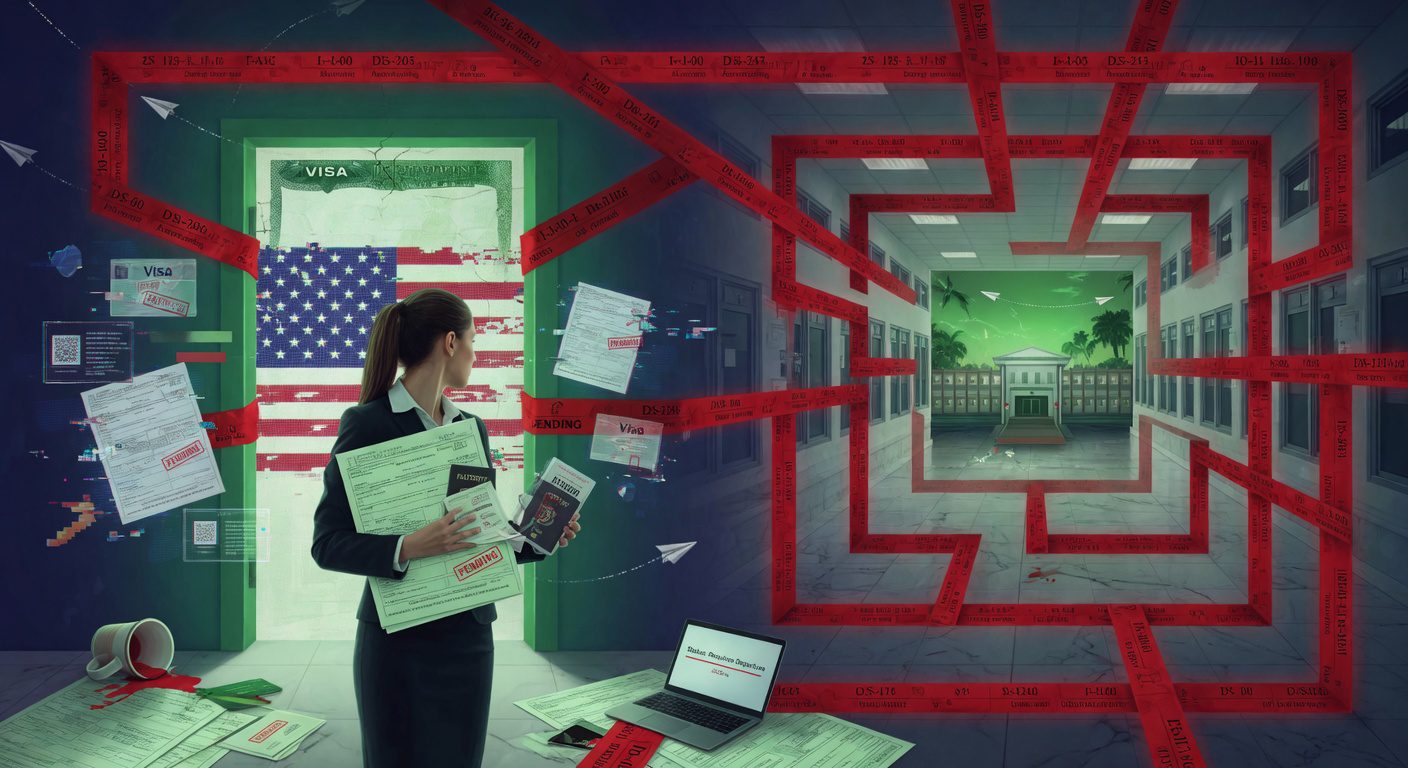
  • When Global Policy Overheats the Local Server: An Immigration Story

    When Global Policy Overheats the Local Server: An Immigration Story

    Imagine you’re the sysadmin for a small, stable, and predictable network. Let’s call it ‘SmallTownUSA.’ The user base is consistent, the uptime is great, and the biggest ticket in the queue is from the mayor, who can’t find the ‘any’ key. Then one morning, without warning, a massive, undocumented patch from Corporate gets force-pushed to your server. The patch is called ‘ICE-RAID_v2.4,’ and it doesn’t come with a readme file. The entire network is about to experience a catastrophic failure, and your only tool is a pot of lukewarm coffee.

    The Unscheduled API Call

    From a systems perspective, a federal raid in a small town is the ultimate unscheduled API call. The local network—the sheriff’s department, the city council, the town’s single traffic light—receives a flood of high-priority requests it was never designed to handle. Suddenly, the town clerk, whose biggest IT problem is usually a paper jam, is expected to interface with a multi-billion dollar federal database that probably still runs on COBOL. It’s a classic compatibility issue. You’re trying to plug a quantum computer into a switchboard operated by a nice lady named Ethel.

    Error 404: Local Economy Not Found

    The primary function of this federal script appears to be removing specific ‘user accounts.’ The problem is, these aren’t just isolated accounts; they are deeply integrated dependencies for the entire local operating system. You can’t just batch-delete a third of the workforce at the local processing plant and expect the ‘LocalEconomy.exe’ module to keep running. The script doesn’t account for the fact that the deleted ‘user’ was also the only person who knew how to fix the industrial dough mixer, which is critical for the annual town bake sale. The result is a cascade of system-wide failures, from supply chain lags to a sudden, sharp decline in demand for pot roast at the local diner.

    When the Patch Creates More Bugs

    The stated goal of any system patch is to improve stability and security. But this particular patch seems to introduce more bugs than it fixes. We’re talking about a denial-of-service attack on the town’s social fabric, corrupted data tables in the community trust index, and a catastrophic failure of the ‘Sense of Normalcy’ kernel. The aftermath isn’t a clean, optimized system; it’s a town full of broken links, orphaned processes, and a desperate need for a system restore from a backup that no one ever made. Maybe the next update could come with a beta test, better documentation, and, for heaven’s sake, a simple confirmation prompt before executing.

  • The Great Starlink Catfish: How Ukraine Tricked Russian Troops

    The Great Starlink Catfish: How Ukraine Tricked Russian Troops

    Ever gotten an email promising you a small fortune from a long-lost prince? Or a frantic message from a ‘friend’ who needs gift cards because they’re ‘stuck’ in another country? Welcome to the internet, where not everything is as it seems. Now, imagine that same energy, but with high-stakes, geopolitical consequences. That’s essentially what happened in the Ukraine-Russia conflict, in a brilliant move we’re calling ‘The Great Starlink Catfish.’ It’s a story about how modern warfare sometimes looks less like a battlefield and more like a very, very elaborate IT support ticket.

    The Bait: What is Starlink, Anyway?

    First, a quick refresher. Think of Starlink as the ultimate Wi-Fi router for when the power’s out and your cell service is a distant memory. It’s a network of satellites from Elon Musk’s SpaceX, zipping around the planet and beaming down internet access to a special dish on the ground. For soldiers in a warzone, having a reliable internet connection is like finding a fully-stocked vending machine in the desert—it’s a game-changer for communication, coordination, and, presumably, morale-boosting cat videos.

    The Scam: “Thank You For Calling Tech Support”

    Here’s where the genius-level trolling begins. Ukrainian forces, knowing that Russian troops were using Starlink terminals (sometimes captured, sometimes bought on the black market), set up a fake tech support hotline. Yes, you read that right. They created the wartime equivalent of the Geek Squad, but with a very different agenda. Picture this: A Russian soldier, frustrated because his internet is buffering right before a crucial update, finds a number for ‘Starlink support.’ On the other end, a Ukrainian operator patiently waits to ‘assist’ them.

    The Hook: “Can You Please Confirm Your Location?”

    The beauty of this tactic lies in its perfect imitation of bureaucratic procedure. The classic tech support script always includes a few key questions to ‘verify your account.’ In this case, the most important one was: “Sir, to better assist you, could you please confirm the serial number of your device?” It’s the ultimate ‘I’m not a robot’ test, except the prize for failing is an artillery strike. The process was brutally simple:

    • A Russian soldier calls the fake support line for help with their connection.
    • The helpful Ukrainian “technician” asks for the terminal’s unique identifier to look up the account.
    • The soldier, just wanting his internet back, provides the info.
    • Ukraine uses that ID to pinpoint the terminal’s exact GPS coordinates in real-time.
    • Suddenly, the soldier’s connection problems become the least of his worries.

    Modern Warfare or an Intense IT Ticket?

    This is a masterclass in 21st-century asymmetrical warfare. It’s low-cost, high-impact, and preys on a universal human experience: the sheer, maddening frustration of technology not working when you need it most. It’s a reminder that in the digital age, the most powerful weapon isn’t always a tank; sometimes, it’s a convincing voice on a fake tech support line. The Great Starlink Catfish proves that the oldest tricks in the book—deception and social engineering—are still the most effective, even when you’re using space lasers to do it.