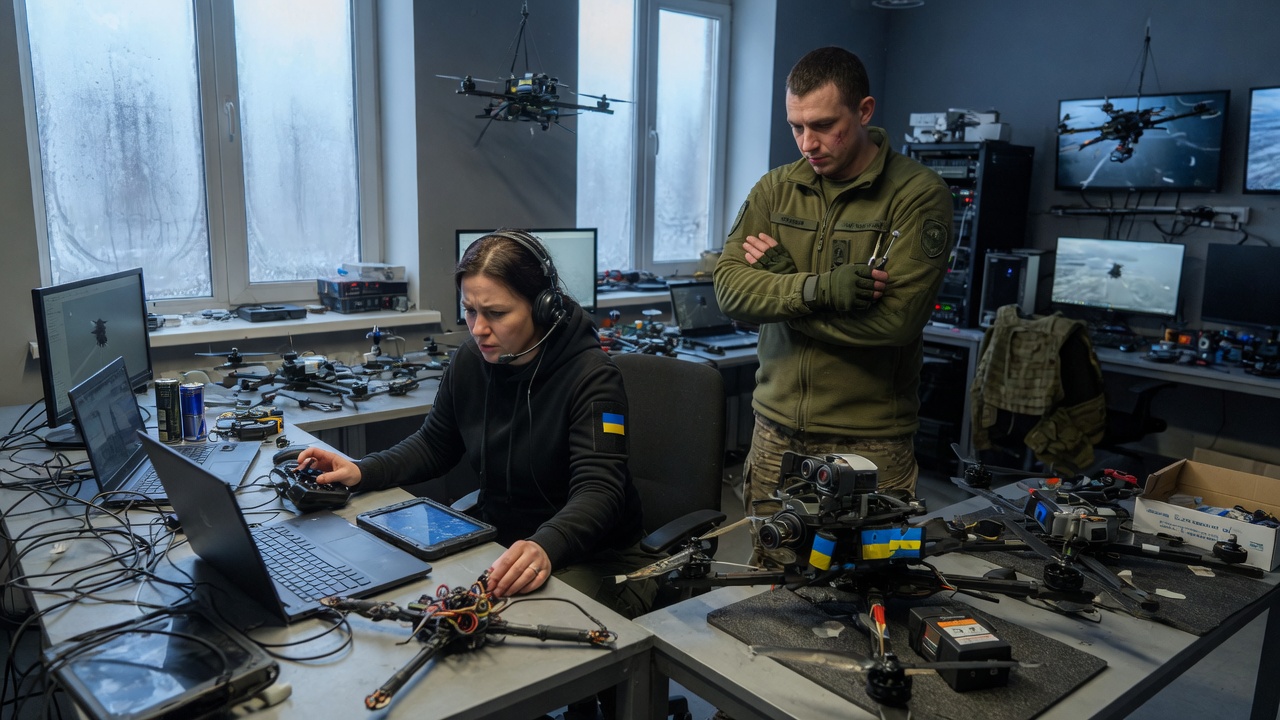
Killer robots” is a phrase that sells clicks and muddies specs. The war in Ukraine is teaching a finer lesson: autonomy is arriving in modules—navigation under jamming, terminal guidance after a link drop, computer-vision lock—while true fire-and-forget target selection at scale is still contested, rare, and politically radioactive.
What is actually shipping
Ukraines Ministry of Defence and the Brave1 cluster have publicly run large tests of drones with automatic guidance against moving ground targets. Official messaging is careful: AI boosts strike effectiveness; a human still decides to fire. MoD reporting in 2026 said successful AI-guided strikes had jumped sharply year-to-date and that more than seventy AI/computer-vision systems were already in use across units. Six of seven vendors cleared a common test profile for procurement recommendations.
That is not science fiction. It is productization: small models on cheap chips, bolt-on guidance modules for FPV and longer-range airframes, and iteration under electronic warfare that makes pure manual piloting brittle.
New Scientist and Ars Technica reported a separate, older claim from Ukrainian industry: a one-off front-line test years earlier with “Terminator mode” quadcopters that searched and engaged without human oversight, with alleged casualties, no public video, and a government posture that still prefers human authorization at the final intercept. Treat that as a reported milestone under dispute—not a doctrine slide you can paste into NATO PowerPoints.
Al Jazeera’s September 2026 reporting describes both sides racing toward more autonomy because jamming and distance make continuous human control expensive. Russian use of commercial AI compute for last-mile strikes has also been alleged in major press analysis. Ukrainian voices such as Serhii “Flash” Beskrestnov publicly distinguish recognition, tracking, and true autonomous target selection—and say the last piece is still early in combat testing.
Sources:
- Ukraine MoD / Brave1 AI guidance testing
- New Scientist on the reported fully autonomous test
- Ars Technica context and CSIS framing
- Al Jazeera: Russia–Ukraine AI warfare race
Failure modes look like IT failure modes
The stub’s fridge-firmware joke was cheap, but the underlying failure taxonomy is fair:
- Link loss. Autonomy exists because radios die under EW.
- Model brittleness. Vision systems misclassify, especially in clutter and spoofed environments.
- Update politics. Who signs off an OTA change when the airframe is in a trench logistics chain?
- Telemetry hunger. Training loops want video and hit data; contested networks do not always deliver.
If your mental model is “Skynet,” you will miss the real near-term risk: massed semi-autonomous munitions that are good enough, cheap enough, and loosely governed.
Policy without cosplay
For tech-policy readers, the live questions are governance and verification:
- Where is the human in the loop—launch, target nominate, or abort only?
- How do you audit onboard models after a strike when the airframe is scrap?
- What export and component controls matter when the “AI” is a phone-class board and an open autopilot fork?
- How do alliances write rules that survive contact with an enemy already fielding last-mile autonomy?
What “failure mid-battle really looks like
Autonomy fails loud and quiet. Loud: wrong target class, mid-course confusion, swarm fratricide risk. Quiet: a guidance module that only works in the vendor’s sunny test range, then underperforms in mud and decoys. Procurement officials who only watch demo days will buy the quiet failure mode.
The MoD/Brave1 shared-scenario testing is the adult response—force vendors onto one course and publish who cleared it.
For Western policy audiences, copy-paste ethics codes that ignore EW reality will be ignored by soldiers whose radios are junk. The workable path is constrained autonomy with audit hooks, not a fantasy of perfect teleoperation at scale. Write rules for the modules that already exist.
Alliance procurement will lag the front
NATO and partner acquisition cycles are slow; Ukrainian iteration is fast. That mismatch is the strategic story under the robot headlines. By the time a Western RFP finishes adjudicating ethics language, a dozen guidance-module vendors may have already shipped firmware bumps from trench feedback. Policy shops should plan for continuous evaluation, not one-time certification theater.
Also drop the fridge reboot joke as your lead. Soldiers deserve better metaphors. Talk about jamming, decoys, and human authorization latency instead.
Bottom line
Ukraine is not waiting for a UN seminar to bolt computer vision onto cheap strike drones. Fully autonomous “killer robots as a daily order of battle remain rarer and more legally constrained than viral language suggests. The systems story is modular autonomy under firemessy, iterative, and already rewriting cost curves. Policy that only debates sci-fi will arrive after the firmware.
Steve Miller — Mason, Ohio. Former programmer, sysadmin, and IT manager. Reads release notes before apocalypse threads.
Leave a Reply