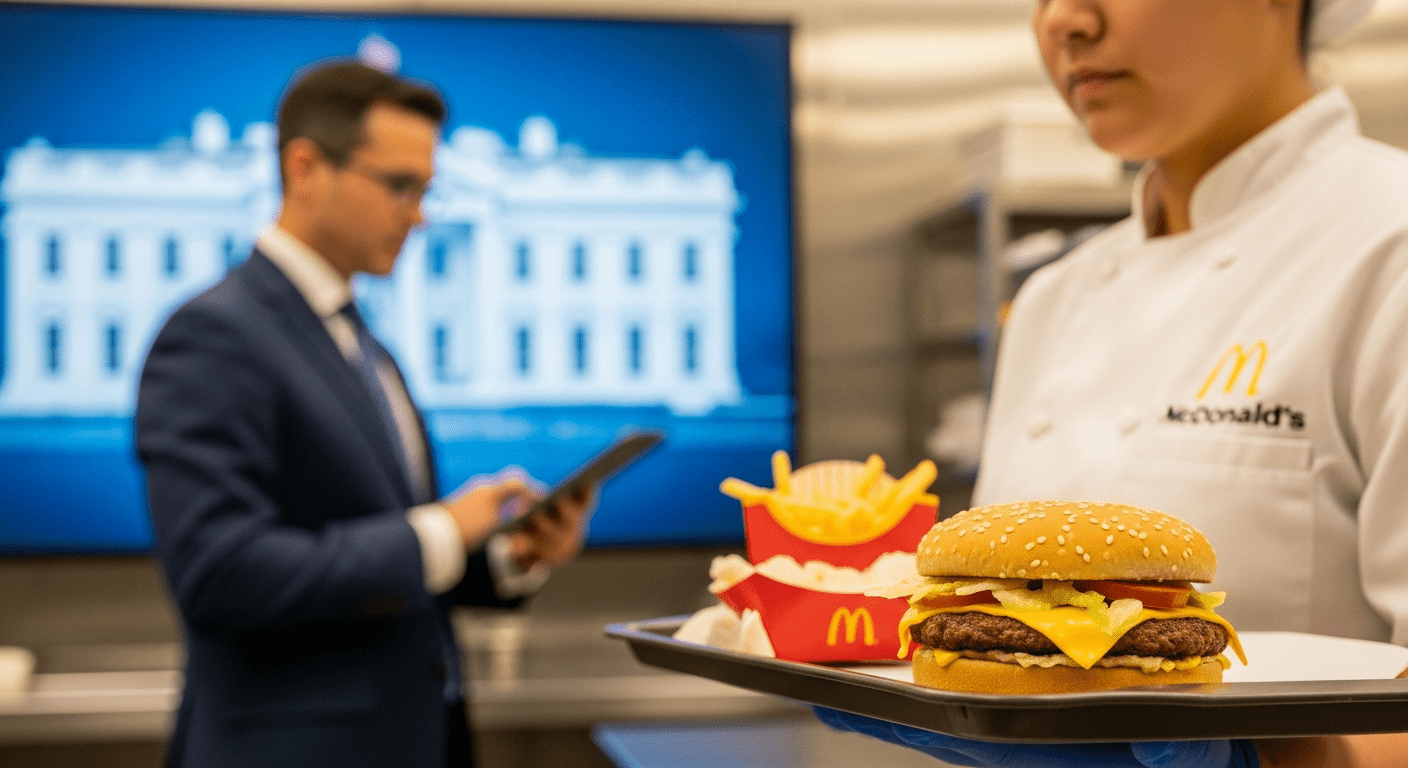
There are few systems on Earth more secure than the White House. It’s the production environment to end all production environments. And yet, a teenager on a moped with a thermal bag containing a Big Mac and fries can, with enough process-following, successfully push a payload to the core. This, my friends, is the ultimate lesson in White House DoorDash delivery logistics, and it’s a terrifyingly accurate metaphor for modern DevOps.
The Pull Request: A Burger and Fries
It all starts with a simple request, initiated from a standard user interface—the DoorDash app. The order itself is the commit message: ‘One #1 combo, large, with a Diet Coke.’ It’s a seemingly benign, well-formed request. The user has valid credentials (a credit card) and the request is sent to a trusted vendor (McDonald’s). So far, so good. This is the feature branch, looking innocent and ready for merging.
The CI/CD Pipeline: A Journey Across D.C.
Once the code is compiled—or the burger is flipped—it’s handed off to our deployment agent: the delivery driver. This is where the pipeline gets interesting. The payload is containerized in a paper bag and placed in a staging environment (the hot bag). The driver navigates a complex network topology (D.C. traffic) to reach the server’s public-facing IP address: 1600 Pennsylvania Avenue.
Penetrating the Firewall
This isn’t your average firewall. This is a multi-layered, stateful, human-powered security apparatus. The initial handshake happens at the gate. The driver’s credentials are checked. Their request headers (the order details) are verified against an internal list. The payload then undergoes deep packet inspection via X-ray. Is it what it claims to be, or is there a vulnerability hidden in the special sauce? Every step is a security scan, a policy check, a two-factor authentication challenge. The entire process is a live penetration test where the payload is lunch.
If a fast-food order can navigate the world’s most stringent security, what does that say about our own digital perimeters? It’s a masterclass in process and vulnerability:
- Zero Trust is Key: The Secret Service doesn’t trust the bag just because it smells like freedom and fries. Every single entity, from the driver to the Coke, is un-trusted until verified. Your network should treat every API call the same way.
- The Human API: Ultimately, the system has an entry point for authorized personnel to receive packages. This is the human API. It’s often the most exploited vector because it’s designed for convenience, whether it’s for official documents or a 10-piece McNuggets.
- Supply Chain Security is Real: Who vetted the cook at McDonald’s? Who built the delivery app? Your software is only as secure as its weakest third-party dependency. In this case, that dependency is a gig worker named Kevin who just wants to make his delivery quota.
So the next time you see a delivery driver looking confused outside an office building, don’t just see a lost lunch. See a live-action depiction of an unauthenticated request trying to breach a firewall. And ask yourself: would my system let the burger through?
Leave a Reply