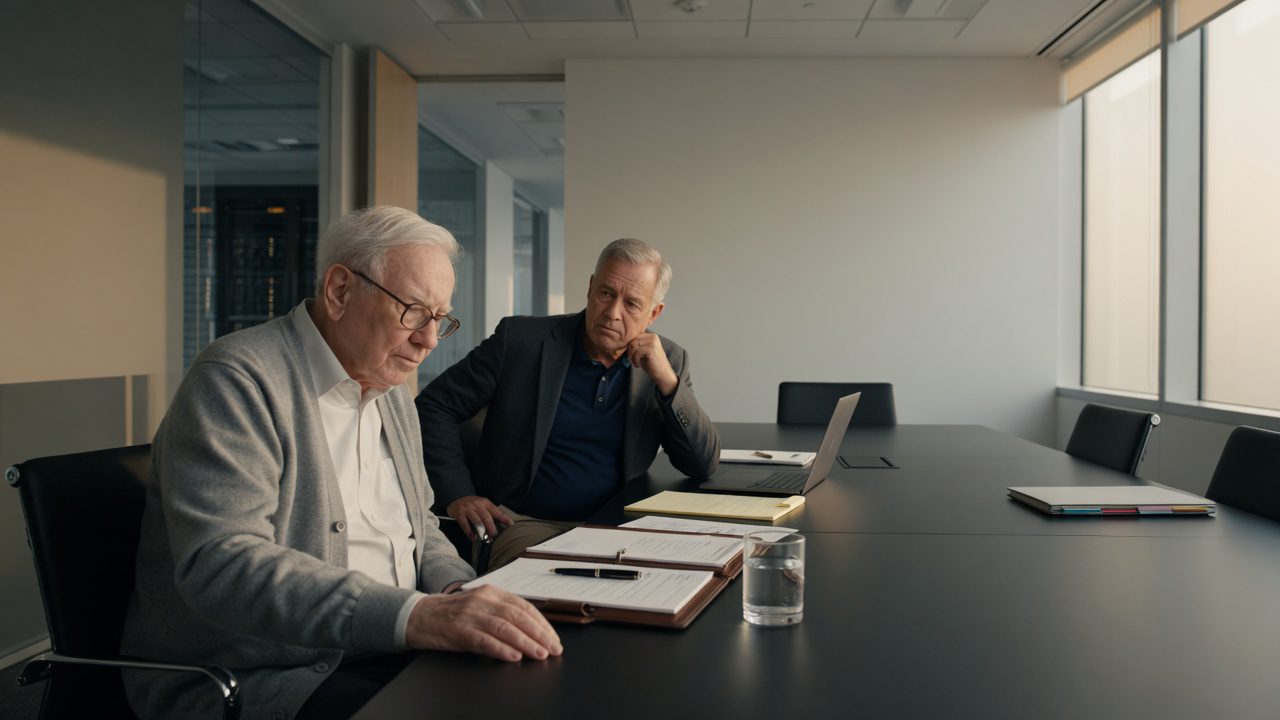
Even legends eventually hand over the keys, and Warren Buffett retirement Berkshire Hathaway succession marks one of the clearest recent examples. The decision to step back as CEO while naming Greg Abel as the planned successor underscores a simple operational truth: no system, no matter how robust, runs forever on a single operator. For investors and builders who manage portfolios the way others manage clusters or data centers, the episode offers a reminder that planning for turnover is not optional.
The Relatable Absurdity of Retirement
Buffett built Berkshire Hathaway into a holding company whose performance has been measured in decades rather than quarters. Yet the announcement that he would step down still landed with a note of surprise, even though the timeline had been signaled for years. The absurdity is familiar to anyone who has watched a senior engineer insist they will never leave, only to announce departure six months later. Father Time applies the same rules to billionaires as it does to on-call rotations: eventual handover is non-negotiable.
Single Points of Failure and Organizational Design
Berkshire’s structure has long relied on a decentralized model where subsidiary managers operate with wide latitude. That approach reduces day-to-day load on the top, but it still concentrates capital-allocation decisions in one office. When succession questions arise, the risk is not immediate collapse but slower drift if the new decision maker applies different heuristics. Operators recognize the pattern: a well-documented runbook reduces blast radius when the primary owner leaves, yet the quality of the runbook itself matters more than its existence.
Warren Buffett Retirement Berkshire Hathaway Succession Planning in Practice
Abel’s elevation has been discussed internally for several years, giving time for cultural transmission. Public filings show the board has reviewed capital-allocation authority and reporting lines in advance. For individual investors, the parallel is straightforward. Relying on any single manager or strategy creates a similar concentration. Diversification across asset classes, time horizons, and decision frameworks functions as the equivalent of active-active redundancy. When one approach degrades, others continue without requiring heroic intervention.
Knowledge transfer also deserves attention. Buffett’s annual letters have served as public documentation of investment logic. Berkshire subsidiaries maintain their own operating histories. Ordinary portfolios benefit from comparable records: written investment policy statements, rebalancing rules, and tax-lot tracking that survive the departure of the original author. Without those artifacts, successors inherit only outcomes rather than the reasoning that produced them.
Change Windows and Monitoring
Leadership transitions are change windows. During such periods, volatility can rise because market participants test the new decision rules. Berkshire’s track record of measured capital moves suggests the window will be managed conservatively, yet the principle remains. Portfolio operators can apply the same caution by widening monitoring thresholds around known transition dates and by pre-authorizing limited responses rather than improvising under pressure. The goal is not to eliminate surprise but to keep the response within tested parameters.
Legacy Systems and the Cost of Delay
Many organizations postpone succession work because current performance remains acceptable. The same pattern appears in personal finance when investors defer estate documents or beneficiary updates. Berkshire’s long runway before the formal step-down illustrates the benefit of early preparation. Once the transition date is set, the remaining tasks are execution rather than invention. Investors who treat legacy planning as a recurring maintenance item rather than a one-time project reach the same state with less last-minute effort.
The market’s reaction to the announcement also provides data. Share-price movement was modest relative to Berkshire’s size, consistent with prior signals that the board had already aligned on the path. That outcome reflects years of incremental disclosure rather than a single surprise event. Comparable transparency in personal planning might include periodic reviews with family members or advisors so that no single document carries the entire weight of the strategy.
Practical Steps for Investors
Begin with an explicit statement of investment objectives and constraints, updated annually. Maintain a simple dashboard that tracks allocation drift and tax consequences without requiring the original author to interpret the numbers. Identify at least one person or institution that can execute the documented policy if needed. Finally, schedule a recurring review of those documents during the same calendar window each year. These steps mirror the basic hygiene practices used in production environments: version-controlled configuration, automated checks, and scheduled failover tests.
Berkshire Hathaway’s transition will continue to unfold over multiple reporting cycles. The company’s scale makes it a visible case study, yet the underlying mechanics apply at any size. Planning for the next operator is not an admission of weakness; it is recognition that every system eventually requires a new primary.
Sources for further reading include the Berkshire Hathaway shareholder letters archive and recent SEC filings detailing governance updates.
Leave a Reply