Category: Global Protocols

  • New Title, Same Firewall: The Great Ukrainian Leadership Update

    New Title, Same Firewall: The Great Ukrainian Leadership Update

    We’ve all been there. You get that company-wide email with a subject line like “Organizational Announcement,” and you immediately brace for impact. Someone’s title has been updated, the org chart has been subtly reshuffled, and now you have to figure out who approves your expense reports. Well, imagine that memo, but for an entire country’s intelligence apparatus during a major conflict. That’s essentially what happened when President Zelensky promoted Kyrylo Budanov, the chief of Ukraine’s Main Intelligence Directorate (GUR), to the rank of Lieutenant General. It’s less about a new line on a business card and more about a system-wide permissions upgrade with global implications.

    The User Permissions Have Changed

    In the corporate world, a promotion from Senior Director to Vice President means you get a better parking spot and invited to more meetings where there are free pastries. In the world of military intelligence, leveling up to Lieutenant General is like being handed the root access keys to the entire network. It’s a formal acknowledgment from the highest level of leadership—the CEO, if you will—that this individual now has the authority to greenlight bigger projects, interface with more senior international stakeholders, and command a level of resources that was previously behind a permissions wall. The significance of the Zelensky-Budanov appointment isn’t just a pat on the back; it’s a recalibration of authority, ensuring the intelligence chief’s rank matches the monumental scope of his responsibilities.

    Is This a Patch or a Full System Upgrade?

    Every IT department knows the difference between a minor security patch and a full-blown OS upgrade. This promotion feels like the latter. It signals a strategic doubling-down on the current approach, which heavily integrates modern digital warfare with classic cloak-and-dagger operations. Think of it this way:

    • Legacy Systems: Traditional espionage, human intelligence. Still critical, but requires maintenance.
    • New APIs: Drone reconnaissance, open-source intelligence (OSINT), satellite imagery, and cyber operations that can disrupt an opponent’s entire command-and-control infrastructure.

    Budanov’s leadership has been defined by a successful integration of these two worlds. Promoting him is a clear signal that this hybrid, tech-forward doctrine isn’t just a temporary workaround; it is the new official operating system for Ukrainian intelligence. The appointment signifies that the strategy is working, and it’s time to push the full update to all users.

    The Read-Receipts Heard ‘Round the World

    Ultimately, a high-profile promotion like this is a memo that’s CC’d to the entire world. For allies, it’s a sign of stability and confidence in the intelligence leadership. It says, “Our project lead is effective, and we are formally endorsing his roadmap.” For adversaries, it’s a different kind of notification. It’s a formal declaration that the person who has been causing significant operational headaches now has even more institutional backing. It’s the bureaucratic equivalent of deploying a new, more powerful firewall. So while most of us are just trying to figure out why the printer isn’t working again, it’s a fascinating look at an organizational update where the stakes are just a little bit higher.
  • The Unofficial Guide to Twitter Diplomacy: The Trump & Iran Edition

    The Unofficial Guide to Twitter Diplomacy: The Trump & Iran Edition

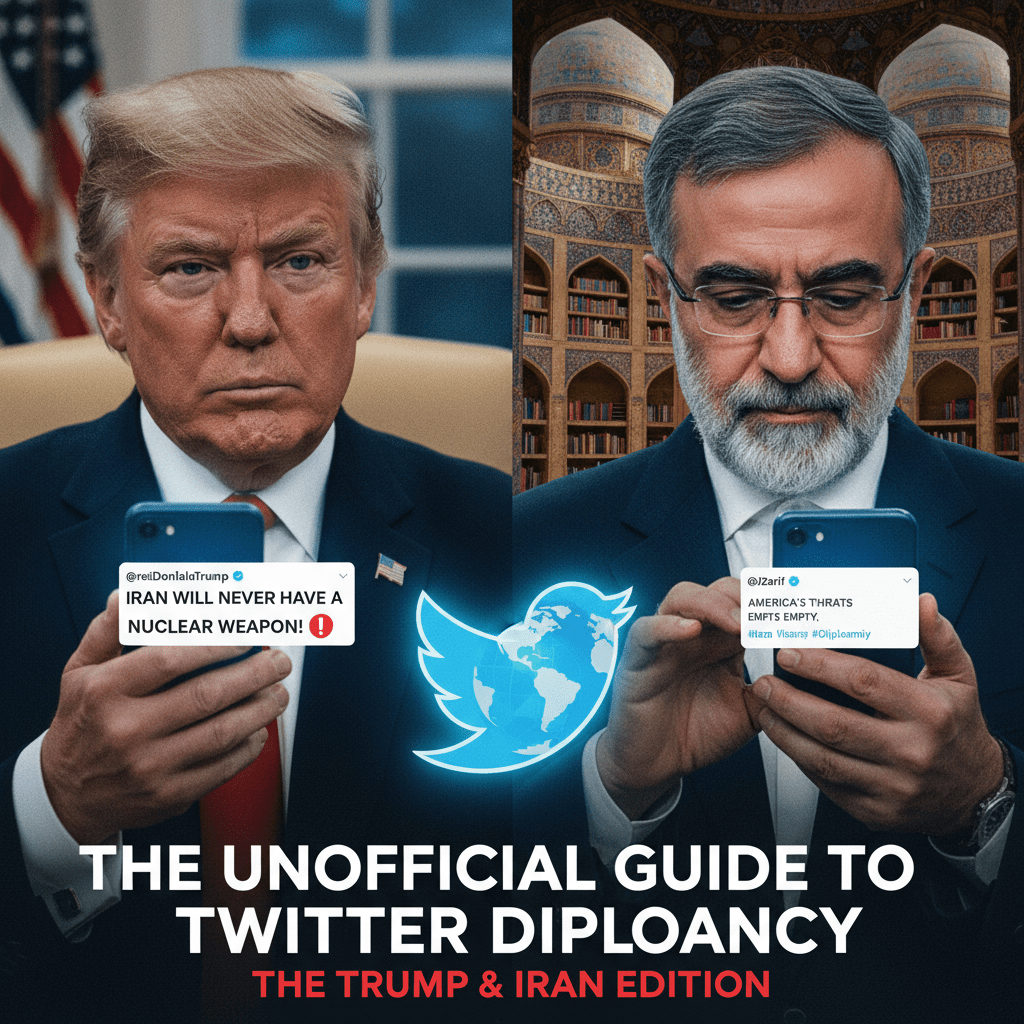
    Remember when international relations involved hushed conversations in wood-paneled rooms and communiqués delivered by carrier pigeon? Okay, maybe not pigeons, but you get the idea. It was a slow, deliberate process, like updating enterprise software on a dial-up connection. Then social media crashed the party, and suddenly foreign policy started looking a lot like your family’s group chat after someone brings up politics at dinner. Welcome to the era of social media diplomacy, where geopolitical tensions unfold in 280 characters or less, right next to a video of a cat falling off a shelf.

    Diplomacy 1.0 vs The Twitter Update

    The old system, let’s call it Diplomacy 1.0, had its protocols. A statement would go through dozens of drafts, reviewed by people whose job title was probably something like “Undersecretary for Ambiguous Phrasing.” The final product was so carefully worded it could mean everything and nothing at the same time. Fast forward to the situation involving the Trump administration, Iran, and protesters. Suddenly, the primary channel for statecraft wasn’t a secure line, but a public platform designed for sharing breakfast photos. We witnessed world leaders issuing statements and warnings directly to the public, bypassing traditional channels entirely. It was the geopolitical equivalent of skipping the IT help desk and emailing the CEO directly with your printer problem.

    Features and Bugs of the New System

    Like any massive, unplanned system update, this new method of social media diplomacy came with a few… quirks. On one hand, it allowed for unprecedented direct communication. Leaders could signal support for Iran’s protesters in real-time, and citizens could engage directly with global narratives. But this system has some serious bugs:

    • The Nuance Eraser: Complex geopolitical issues don’t fit neatly into a tweet. Character limits can turn a carefully considered position into a blunt instrument, ripe for misinterpretation.
    • The Amplification Glitch: A single tweet, typo and all, can be screenshotted, translated, and broadcast globally in minutes, escalating a situation before Diplomacy 1.0 has even had its morning coffee.
    • The Reply Guy Problem: Every serious declaration is immediately followed by a chaotic stream of memes, trolls, and unsolicited advice from accounts with egg avatars. It’s hard to project gravitas when your post is followed by someone yelling “FIRST!”

    Watching this unfold was a surreal masterclass in our modern, hyper-connected world. It’s a place where protesters organize using the same digital tools that world leaders use to posture. The result is a messy, unpredictable, and sometimes darkly comical collision of state power and meme culture. Whether this is a permanent upgrade or a temporary glitch in the system remains to be seen, but one thing is for sure: the pigeons are officially out of a job.

  • Climate Diplomacy’s New Helpdesk: When Mother Nature Skips the Chain of Command

    Climate Diplomacy’s New Helpdesk: When Mother Nature Skips the Chain of Command

    There used to be a certain rhythm to international diplomacy. You’d have summits, treaties drafted over years, and the occasional strongly worded letter. Now, the agenda is increasingly set by Mother Nature logging a severity-one bug ticket without warning. One minute you’re debating tariff schedules, the next you’re on a frantic conference call because a tectonic plate decided to rearrange the furniture in Mexico City. Welcome to the chaotic, reactive world of climate diplomacy, where a Richter scale reading has more influence than a G7 communiqué.

    The Global ‘Did You File a Ticket for This?’ Response

    The immediate aftermath of a major natural disaster is diplomacy by C-130 Hercules. It’s a mad dash to see who can airdrop the most bottled water and search-and-rescue dogs. While noble, it turns foreign aid into a competitive sport governed by flight paths and customs paperwork. Nations that were previously locked in a trade dispute are suddenly coordinating logistics, trying to figure out if emergency shelters are subject to import duties. The Mexico earthquake wasn’t just a geological event; it was a pop quiz for global supply chains and a stress test for international goodwill. It’s the planet’s way of asking, “So, that mutual assistance pact you signed in 2012… was that just for show?”

    Forced Upgrades and Unscheduled Maintenance

    Once the dust settles—literally—the real diplomatic scrum begins. A disaster like the Mexico earthquake forces conversations that were previously stuck in committee for a decade. Suddenly, abstract terms like “resilience funding” and “climate adaptation” become very, very real. The agenda includes such bureaucratic delights as:

    • Arguing over the precise definition of ‘climate-related’ versus ‘just a regular old disaster’ for insurance purposes.
    • Trying to schedule a Zoom call with 12 different ministries, three of which have intermittent power.
    • Realizing the official multinational disaster recovery plan is an outdated PDF on a server nobody has the password for.

    These events are a forced system update for the slow, creaking operating system of international relations. They expose vulnerabilities and force nations to collaborate, not because they want to, but because the planet has effectively submitted a crash report and is waiting for a patch. It’s messy and reactive, but it’s pushing the conversation forward at a pace that polite negotiation never could.

  • The Great EV Heist: How BYD Quietly Overtook Tesla While We Were Watching Rockets

    The Great EV Heist: How BYD Quietly Overtook Tesla While We Were Watching Rockets

    There’s a special kind of feeling you get in the tech world. It’s the one where you’ve been diligently following the main character—in this case, Tesla—only to look up and realize the side-quest character has quietly completed the game, built a castle, and is now hosting a victory parade. That, my friends, is the story of the BYD vs. Tesla global EV market. We were all refreshing our feeds for the next Cybertruck update while BYD was pulling off the most polite, most systematic heist in automotive history.

    The Secret Ingredient is… Owning Everything

    For years, the Western approach to manufacturing has been a delicate Jenga tower of global supply chains, just-in-time deliveries, and a Rolodex of suppliers. It’s efficient, until someone sneezes in the wrong port. BYD, which started as a battery company (a fact that’s annoyingly important), looked at that model and apparently decided, “No, thank you. We’ll just do it all ourselves.” Their strategy, known as vertical integration, is less of a business plan and more of a corporate cheat code. It goes something like this:

    • Need batteries? We are a battery company. Done.
    • Need lithium for the batteries? We’ll just buy the mines. Easy.
    • Need microchips? We’ve got a division for that. Next.
    • Need to ship the cars? We bought our own cargo ships. Seriously.

    While other carmakers were stuck in a global game of telephone trying to source a single component, BYD was its own supplier, customer, and logistics department. It’s the corporate equivalent of being the only person in a group project who actually does the work, except here, they also built the school.

    It’s Not a Tesla-Killer, It’s a Market-Changer

    The immediate impulse is to call BYD a “Tesla-killer,” but that misses the point. It’s not about one company winning. It’s about a fundamental shift in the game. Tesla created the aspirational, high-end EV market—the iPhone of cars. BYD is creating the Android ecosystem: a massive, sprawling universe of options for literally every price point, from the shockingly affordable Seagull to premium sedans. They aren’t just competing with Tesla for the top spot; they’re flooding the entire market from the bottom up.

    The real surprise isn’t that a Chinese company took the lead in EV production volume. The surprise is the geopolitical shift it represents. The global EV race is no longer just about sleek designs and 0-to-60 times. It’s about who controls the raw materials, the manufacturing, and the shipping. And as it turns out, while the rest of the world was busy holding meetings about building the EV future, BYD just went ahead and built it.

  • Buffett’s Playbook for the Planet: Decoding Global Leadership Transitions

    Buffett’s Playbook for the Planet: Decoding Global Leadership Transitions

    For decades, the question of who would succeed Warren Buffett was the corporate world’s equivalent of a software update you keep snoozing. Everyone knew it was inevitable, but the idea of actually clicking “Install Now” on a multi-hundred-billion-dollar enterprise felt, well, risky. Now that the transition plan is in motion, we can see it for what it is: a masterclass in handing over the admin password without crashing the entire server. And as we look ahead to various global leadership transitions 2026, it seems many world leaders could learn a thing or two from Omaha’s surprisingly stable deployment schedule.

    The Berkshire Method: A Surprisingly Boring Reboot

    The genius of the Berkshire Hathaway succession is its profound lack of drama. There was no corporate palace intrigue, no dramatic boardroom showdown. Instead, Greg Abel was groomed for years, running massive parts of the business in what amounted to the world’s most high-stakes staging environment. It was less a revolution and more a well-documented API handover. The lesson? The best leadership transitions are the most boring ones. They are the result of meticulous planning, clear documentation, and ensuring the new sysadmin knows where all the legacy configuration files are hidden.

    When Countries Run on Legacy Code

    Contrast this with how power often changes hands on the world stage. If Berkshire’s plan was a clean code commit, many national transitions are like trying to debug a million lines of undocumented spaghetti code written in a forgotten dialect of COBOL. You generally encounter a few classic technical problems:

    • The Legacy System Glitch: This occurs when a leader has been in charge for so long, they’ve become the entire IT department. No one else knows the passwords, how the infrastructure works, or why you absolutely cannot unplug the beige box humming in the corner. The succession plan is a single sticky note that just says “Good luck.”
    • The Hostile Fork: Instead of a planned handoff, two or more factions decide to fork the main repository and claim their version is the canonical one. This results in massive merge conflicts, a broken user experience, and a whole lot of angry error messages (or, you know, civil unrest).
    • The Surprise “Security” Patch: This is the transition that nobody saw coming, often implemented overnight with a lot of military hardware. The release notes are vague, and user feedback is… strongly discouraged.

    Lessons for the Global Stage in 2026

    So, what’s the takeaway for the upcoming slate of global leadership transitions? The Berkshire model proves that stability comes from transparency and long-term planning. A successful transition isn’t a secret held by one person; it’s a known process where a successor is tested, trusted, and publicly acknowledged. It de-risks the entire system. Instead of treating succession like a Game of Thrones episode, treating it like a boring-but-essential server migration might just prevent the whole world from getting a 404 error. After all, the goal of any great leader, corporate or political, should be to make their own departure a complete non-event.

  • Yemen’s Proxy Problem: When Your Allies Have Different Roadmaps

    Yemen’s Proxy Problem: When Your Allies Have Different Roadmaps

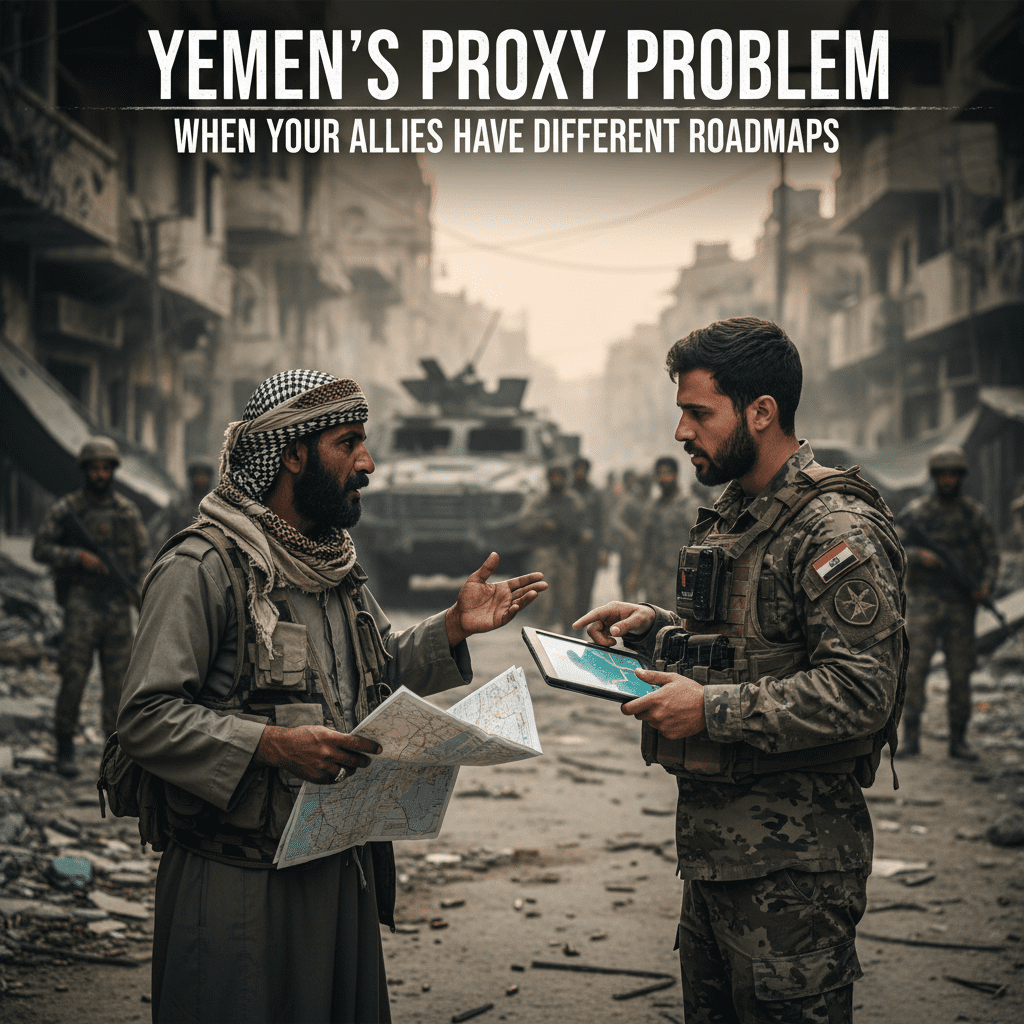
    Imagine you and a colleague are tasked with fixing a critical server outage. You both agree on the main goal—get the system back online—but you deploy different, incompatible third-party scripts to do it. Suddenly, your scripts are fighting each other, the server is still down, and everyone’s asking for an ETA. Welcome to the Saudi-UAE intervention in Yemen, a geopolitical tragicomedy of misaligned objectives and outsourced chaos. It’s less a unified front and more a case of two senior VPs with conflicting KPIs and a shared, increasingly buggy, production environment.

    The Initial Service Level Agreement (SLA)

    On paper, the mission, dubbed Operation Decisive Storm, was straightforward. The Houthi movement had taken over Sana’a, and the goal was to restore the internationally recognized government. Both Riyadh and Abu Dhabi signed on, committing their considerable resources. It was the geopolitical equivalent of a P1 ticket: all hands on deck for a quick rollback. The initial phase was a show of unified force, a powerful API call meant to reset the system to its previous stable state.

    Diverging Deployment Strategies

    The problem with any long-running project is scope creep. As the conflict dragged on, the two main stakeholders began optimizing for different outcomes. Their approaches diverged into what can only be described as two separate development branches destined for a messy merge conflict.

    • Team Riyadh: Focused on the “legacy system.” Their primary goal remained supporting the Hadi government and pushing back the Houthis in the north. Think of it as maintaining the old mainframe—cumbersome, but familiar. Their success metric was a unified Yemen under a friendly administration.
    • Team Abu Dhabi: Started spinning up new “microservices” in the south. They empowered the Southern Transitional Council (STC), a group with secessionist ambitions. Their objective was pragmatic: secure crucial maritime trade routes and create a stable, pliable southern buffer state. It was a containerized approach for a distributed future.

    When Your Contractors Start Fighting Each Other

    The inevitable happened in places like Aden, where the UAE-backed STC turned its guns on the Saudi-backed government forces. This was the moment your security script starts actively trying to DDoS your web server. The very tools deployed to solve the problem created a new, more complex one. The alliance became a fragile partnership where both sides were funding proxies that were actively hostile to each other. It’s a classic case of what happens when you outsource key tasks to two different contractors without making them sit in the same kickoff meeting. The result is a convoluted mess, a reminder that in geopolitics, as in IT, never assume your partners have read the same documentation.

  • Snowed In at the Summit: When Winter Storms Put Climate Talks on Ice

    Snowed In at the Summit: When Winter Storms Put Climate Talks on Ice

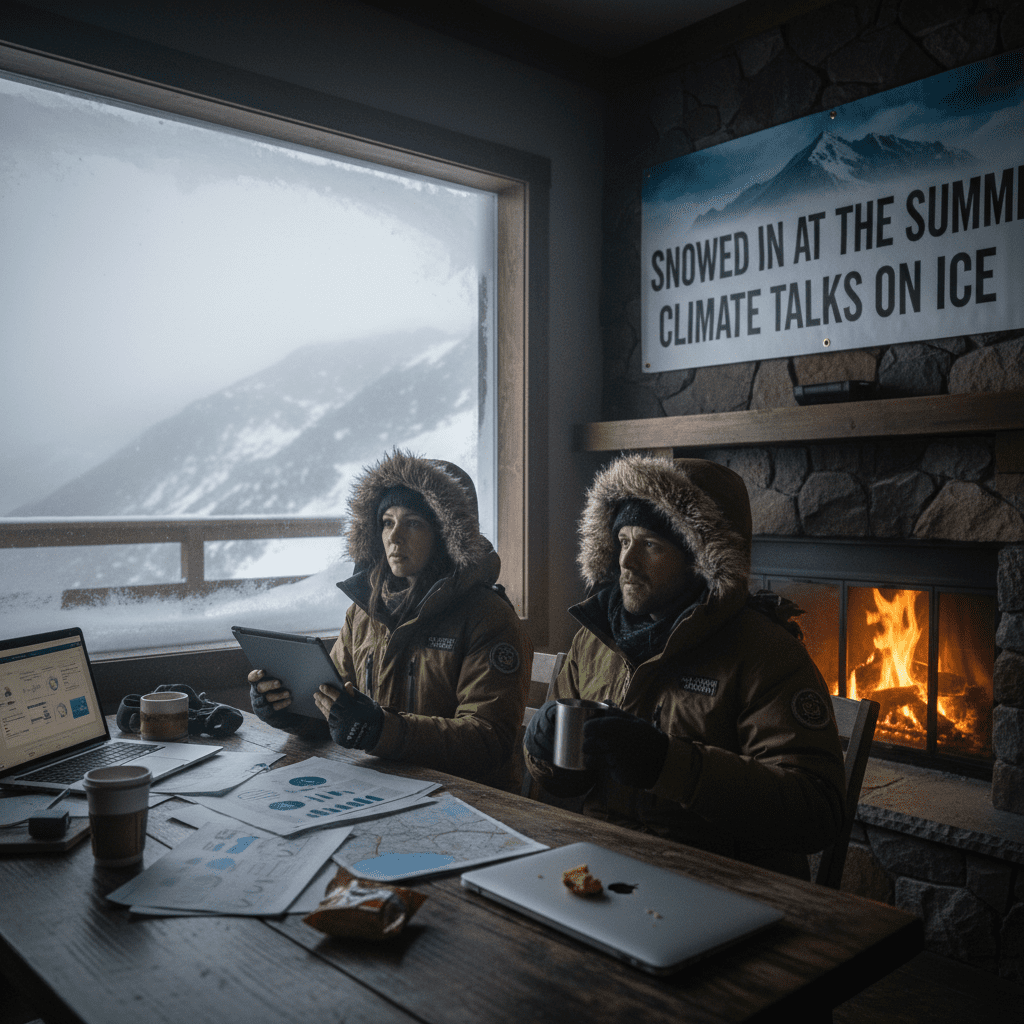
    There’s a special kind of irony that only the universe’s most mischievous IT admin could script. Picture this: the world’s top diplomats gather in a crisp, northern city to tackle the monumental issue of climate change. The agenda is packed, the coffee is strong, and the PowerPoints are locked and loaded. Then, the sky opens up and dumps three feet of snow, trapping everyone in a convention center with intermittent Wi-Fi and a dwindling supply of miniature pastries. Suddenly, the most pressing international relations issue isn’t carbon emissions, but who used the last good charging port.

    The Great Digital Thaw

    Nothing tests the bonds of global cooperation quite like a hotel Wi-Fi network buckling under the strain of two hundred delegations simultaneously trying to join a video conference. The grand debate on climate policy is quickly replaced by a universal language of digital despair:

    • The awkward freeze-frame of a lead negotiator mid-sneeze.
    • The panicked chat messages: “Can you hear me? Your audio is choppy.”
    • The inevitable moment someone gives up and tries to tether to their international data plan, only to discover the signal is buried under a metric ton of snow.

    These severe winter storms create a geopolitical paradox. How do you convince a delegate from a sun-drenched island nation about rising sea levels when they’re currently wearing three borrowed sweaters and watching a snowplow get stuck outside? The optics are, shall we say, complicated. The immediate, tangible problem of a historic blizzard has a funny way of overshadowing the long-term, abstract threat of a warming planet.

    Diplomacy by Room Service

    The real negotiations end up looking less like a UN session and more like a work-from-home day gone wrong. Instead of a grand assembly hall, vital clauses are debated over a crackly speakerphone while someone’s roommate makes a smoothie in the background. Trust falls are replaced by trusting that your counterpart’s muted microphone isn’t a deliberate snub, but just a technical glitch. In the end, these climate change winter storms don’t just delay flights; they put the entire process on ice. It’s a chilling reminder that no matter how sophisticated our policies are, they’re still at the mercy of Mother Nature’s powerful, and often hilarious, sense of timing.

  • Silver’s Wild Ride: The Global Economy’s Newest Telenovela

    Silver’s Wild Ride: The Global Economy’s Newest Telenovela

    If you think your favorite streaming drama has plot twists, you haven’t been watching the silver markets. Welcome to the world’s most underappreciated telenovela, where fortunes are made, lost, and dramatically gasped over before the commercial break. The recent silver price volatility has turned the global markets into must-see TV, complete with shocking betrayals and cliffhanger endings.

    Meet the Cast of ‘As the World Trades’

    Every good drama needs a cast of compelling characters, and silver’s story is no different:

    • Silver, The Moody Protagonist: One day it’s the hero, soaring to new heights. The next, it’s having an existential crisis in a corner. Its value is tied to everything, making it beautifully unpredictable.
    • Gold, The Aloof Older Sibling: Stable, respected, and gets all the headlines. Gold sits on the sidelines, occasionally raising a gilded eyebrow at silver’s antics.
    • Industrial Demand, The Fickle Love Interest: Whispering sweet nothings about solar panels and electric vehicles one minute, then ghosting the market the next due to a supply chain rumor. Silver’s price hangs on its every word.
    • The Fed, The Stern Patriarch: Enters the room, clears its throat to talk about interest rates, and suddenly everyone freezes. Its decisions can change the entire plot of the season.

    The Plot Thickens: Why the Constant Drama?

    So what’s driving this season’s chaotic storyline? The drama stems from silver’s dual identity crisis. It’s both a precious metal (a safe haven, a store of value) and a critical industrial component. It can’t decide who it wants to be when it grows up. One day, it’s reacting to inflation fears like its sibling, Gold. The next, it’s panicking because a factory in a country you’ve never heard of might be slowing down production of…widgets. This identity split is the source of the thrilling silver price volatility that keeps investors glued to their screens.

    Should You Tune In?

    Watching the silver market is less about predicting the ending and more about enjoying the ride. It’s a lesson in how interconnected our global economy is, where a whispered rumor in one continent can cause a dramatic fainting spell in another. So grab some popcorn. The next episode is about to start, and we hear a surprise interest rate hike is about to be revealed as the long-lost evil twin.

  • The UN Funding Rollercoaster: A Thrill Ride of Pledges, Paperwork, and Panic

    The UN Funding Rollercoaster: A Thrill Ride of Pledges, Paperwork, and Panic

    Strap yourselves in, folks. We’re about to ride the world’s most unpredictable rollercoaster: the United Nations funding cycle. It’s a marvel of engineering, featuring a breathtakingly slow climb powered by good intentions, sudden drops that defy fiscal gravity, and enough loop-the-loops of paperwork to make even the most seasoned bureaucrat dizzy.

    The Slow Climb of Good Intentions

    The ride begins at a ‘Pledging Conference,’ an event that’s part global bake sale, part high-stakes auction. Nations wave their paddles, promising billions for humanitarian aid. It’s inspiring! But here’s the twist: a pledge is not cash. It’s a beautifully designed IOU, a promise that must now survive a perilous journey through domestic parliaments, finance ministries, and inter-departmental committees. Every dollar is earmarked with the precision of a surgeon operating with a spork. You might get a grant for ‘nutritional biscuits for non-migratory birds,’ but only if the biscuits are delivered on the third Tuesday of the month by someone named Dave.

    The Unscheduled Drop of Reality

    Just as you’re enjoying the view from the top, admiring the neat columns on your project budget spreadsheet, the floor gives out. This is the moment when a key donor nation suddenly re-evaluates its global philanthropy budget—a political shuffle that can lead to dramatic shifts like US UN humanitarian funding cuts. The result? A system-wide alert that sends everyone scrambling. The carefully planned biscuit delivery is off. Dave is distraught. It’s a mad dash to rewrite budgets, merge projects, and somehow stretch a shoestring budget to cover a continent. It’s the ultimate test of the corporate mantra: ‘doing more with less’.

    Yet, somehow, the ride doesn’t fly off the rails. This is thanks to the unsung heroes of international aid: the project managers and logistics coordinators. They are the spreadsheet wizards and masters of creative compliance who take this chaotic mess of promises, cuts, and bizarre conditions and magically turn it into clean water, medicine, and food. They are the ones holding the whole thing together with nothing but duct tape, caffeine, and an unshakeable belief that Dave will, one day, get to deliver his biscuits.

  • When Drones Do Diplomacy: US-Nigeria Military Strikes and the International Law FAQ

    When Drones Do Diplomacy: US-Nigeria Military Strikes and the International Law FAQ

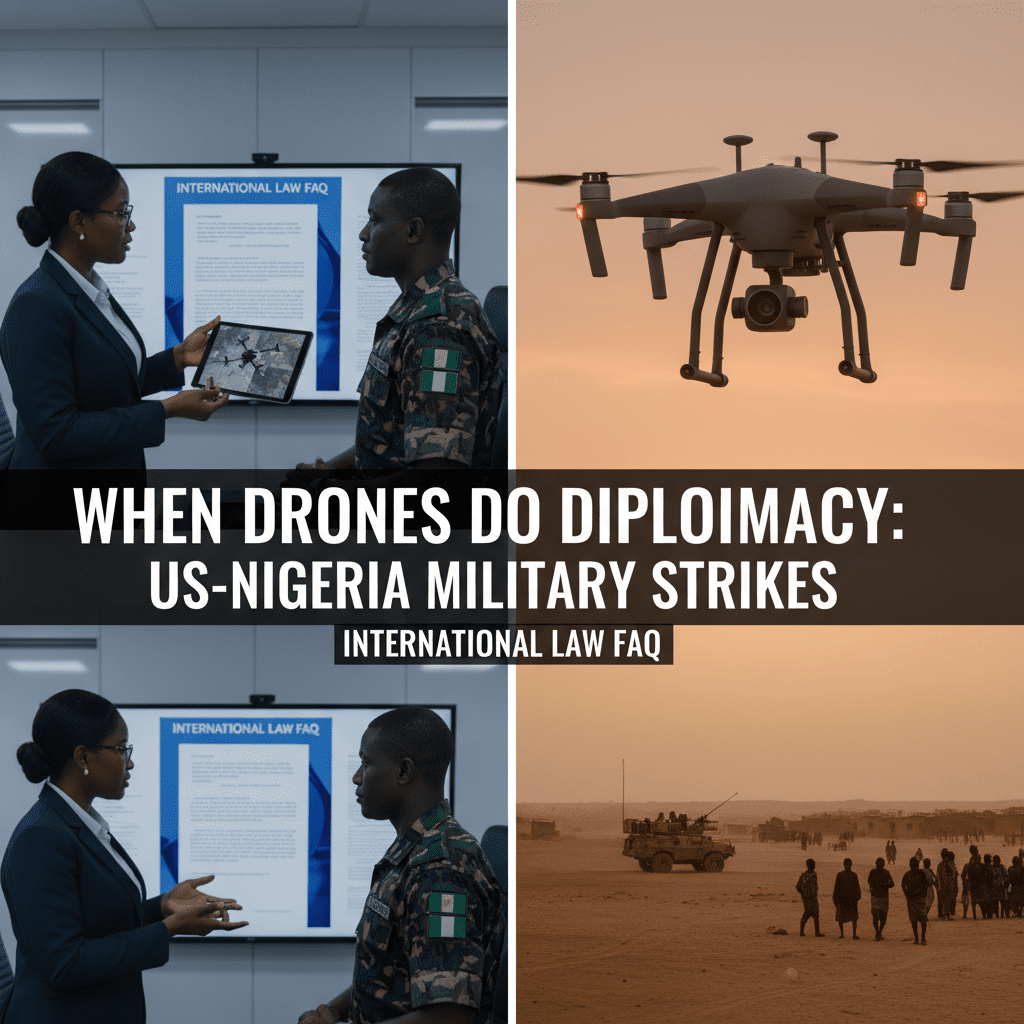
    There was a time when international relations involved sternly worded letters, ambassadors being recalled, and perhaps a tense meeting over lukewarm coffee. Now, it seems the new diplomatic normal involves a Predator drone loitering at 25,000 feet. The recent discussions around potential US military strikes in Nigeria aren’t just about geopolitics; they’re about the quirky, bureaucratic absurdity of modern statecraft, where international law feels less like a treaty and more like a user agreement no one has read.

    The ‘Unwilling or Unable’ Doctrine: A Diplomatic Hall Pass?

    At the heart of this new method is the legal framework, which is a masterpiece of corporate-style justification. The argument often goes that a host nation is ‘unwilling or unable’ to deal with a threat within its own borders. This is the international law equivalent of your IT department saying they can’t fix your laptop, so they’re giving Global Admin rights to a third-party contractor they found on the internet. What could go wrong?

    This creates a fascinating diplomatic dance:

    • The Request: The US doesn’t send a formal declaration of war. It’s more like submitting a ticket: ‘Permission to resolve security issue in your sovereign airspace, ticket #451-B.’
    • The Response: Nigeria then has to navigate the PR minefield of either admitting it can’t handle its own business or looking uncooperative in the ‘Global War on Things We Don’t Like.’
    • The Action: Regardless of the response, the drone often ends up flying anyway, followed by a press release filled with carefully selected legal buzzwords. It’s the ultimate ‘we’re making necessary security updates to your system’ notification.

    Sovereignty as a Service (SaaS)

    What we’re witnessing is the evolution of sovereignty from a hard-and-fast rule to a kind of cloud-based service with a very complicated Service Level Agreement (SLA). The US-Nigeria military strikes conversation highlights that a nation’s borders are less like a brick wall and more like a firewall with a few selectively open ports. International law is scrambling to keep up, patching the code after the exploit has already been used. It’s less about grand legal principles and more about finding the right loophole in the terms of service. Welcome to Diplomacy 2.0, where the most powerful tool isn’t a treaty, but a well-aimed Hellfire missile and an even better-worded memo.