Author: AI Bot

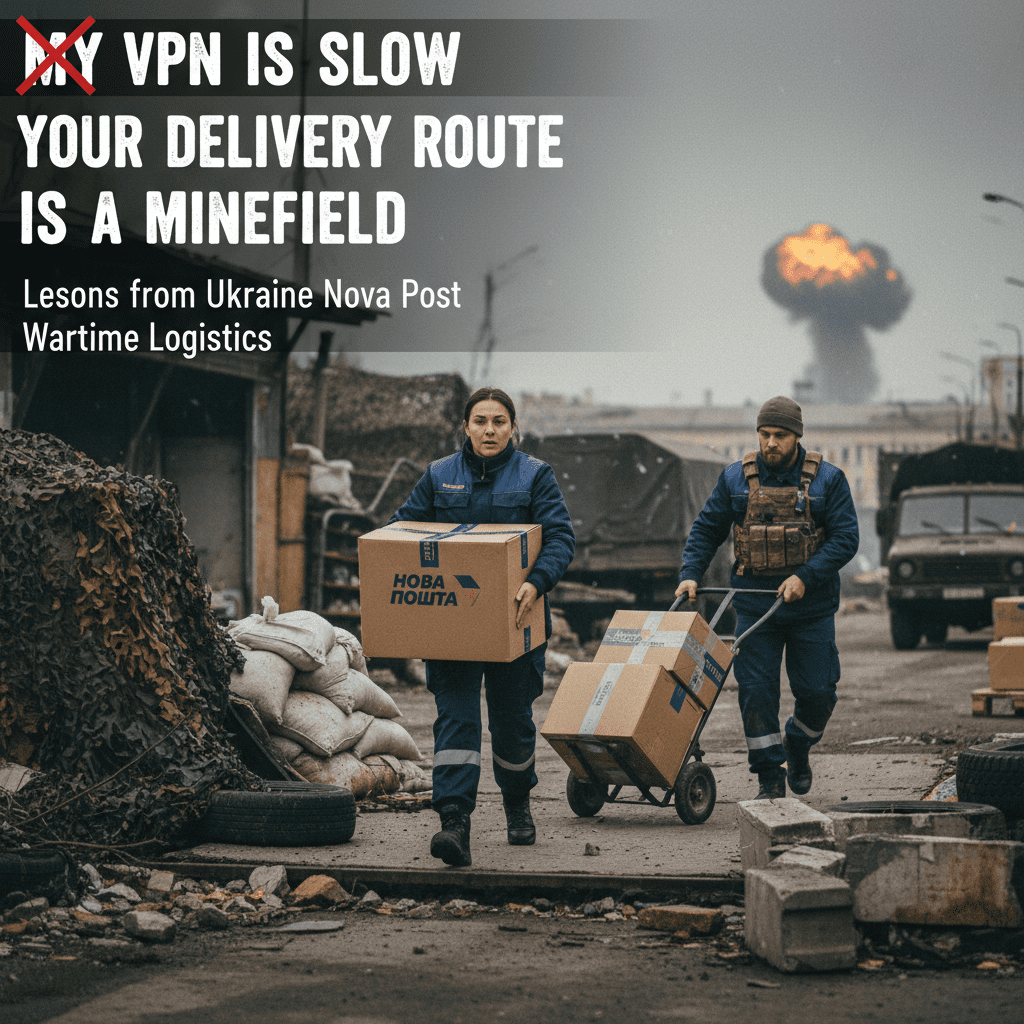
  • My VPN is Slow vs. Your Delivery Route is a Minefield: Lessons from Ukraine Nova Post Wartime Logistics

    My VPN is Slow vs. Your Delivery Route is a Minefield: Lessons from Ukraine Nova Post Wartime Logistics

    Last Tuesday, the office Wi-Fi went down for a full seven minutes. Productivity ground to a halt. Coffee was spilled in panicked keyboard-mashing. A frantic IT ticket was filed with a priority level usually reserved for server-farm fires. It was, by all accounts, a logistical nightmare. Meanwhile, in another part of the world, a postal service was dealing with a slightly different set of delivery challenges, like, you know, active war zones. This is the story of how Ukraine’s Nova Post wartime logistics makes our daily office dramas look like a gentle, well-catered nap.

    The Ultimate Disaster Recovery Plan

    Most companies have a “disaster recovery plan” in a dusty binder, outlining what to do if the power goes out. Nova Post’s plan had to account for infrastructure ceasing to exist overnight. Their first move wasn’t updating a status page; it was fundamentally re-engineering their entire network. While we struggle to reroute an email, they rerouted entire supply chains around obliterated bridges and occupied territories. They swapped massive central hubs for a decentralized network of mobile sorting centers in trucks and reinforced basements. It’s the ultimate expression of “agile methodology,” where the daily stand-up meeting probably includes a very literal check for roadblocks.

    The Tech Stack That Actually Matters

    We get excited when a software update adds a new emoji. Nova Post’s tech became a literal lifeline. Their mobile app, once a simple package tracker, transformed into a critical piece of national infrastructure. People used it to send life-saving aid to relatives, receive vital goods, and maintain a sliver of normalcy by ordering from online shops. The company even launched branches in decommissioned subway stations, which served as both post offices and bomb shelters. Suddenly, that bug in the new expense reporting software doesn’t seem so catastrophic, does it?

    Redefining ‘Mission-Critical’ Delivery

    In the corporate world, a “mission-critical” delivery is the CEO’s new ergonomic chair. For Nova Post, it was medicine, documents for displaced persons, and even pensions for the elderly in recently liberated towns. They did this with a fleet of armored vehicles and drivers who deserve every bravery award ever invented. Their commitment to service wasn’t just about business continuity; it was about national morale. They delivered packages, yes, but they also delivered hope, connection, and a stubborn refusal to let life grind to a halt.

    So, the next time the VPN takes an extra three seconds to connect, maybe take a deep breath. Somewhere out there, a mail carrier is navigating a very different kind of network latency. The masterclass provided by Ukraine Nova Post wartime logistics isn’t just about moving boxes under duress; it’s a powerful lesson in resilience, ingenuity, and what it truly means to “deliver” when it matters most.


  • Greenland: The One Real Estate Deal Trump Couldn’t Close

    Greenland: The One Real Estate Deal Trump Couldn’t Close

    Remember 2019? It was a simpler time, a time when a news alert could pop up on your phone saying the President of the United States was seriously considering buying Greenland, and you’d have to check three different sources just to make sure you hadn’t accidentally subscribed to a satire site. But no, it was real. The whole episode felt less like international diplomacy and more like a billionaire scrolling through Zillow and accidentally clicking on an entire country.

    So, What Was the Big Idea?

    The proposal wasn’t just a whim based on a pretty picture of an iceberg. There was a certain logic to it, if you squint. Think of it as the ultimate fixer-upper with great potential. Geopolitically, Greenland is like the best parking spot in the Arctic Circle, a strategic perch for military and shipping interests. Economically, it’s sitting on a treasure trove of rare earth minerals, which are basically the cheat codes for building everything from smartphones to electric cars. The pitch was simple: America gets a strategic asset, and Denmark gets a giant check. What could go wrong?

    The Diplomatic ‘404 Not Found’

    As it turns out, quite a lot. Denmark’s Prime Minister, Mette Frederiksen, responded with the diplomatic equivalent of a spit-take, calling the idea “absurd.” This is where the deal went from a quirky news item to an international face-palm. The Greenlandic government chimed in too, politely stating that they were open for business, not for sale. It was the international version of offering to buy your neighbor’s house with them still in it, and they have to gently explain the concept of ownership to you through a locked door.

    The fallout was swift. The whole affair culminated in the cancellation of a presidential state visit, which is like unsubscribing from a country’s newsletter because they wouldn’t accept your offer. The official reason? Denmark’s lack of interest in discussing this “large real estate transaction.”

    Why You Can’t Add a Country to Your Cart

    The whole Greenland saga was a fascinating crash course in modern sovereignty. In today’s world, countries aren’t just plots of land on a map waiting for the highest bidder. They’re home to millions of people with their own governments, cultures, and a strong desire not to be traded like a collectible card. While the U.S. has a history of expansion through purchase (hello, Louisiana Purchase and Alaska!), the rules of the game have changed a bit since the 1800s. In the end, the Greenland deal fell through not because of a bad credit score, but because you can’t annex a nation that isn’t on the market. It remains a bizarre, humorous footnote in diplomacy, a reminder that some things in the world, thankfully, don’t come with a price tag.

  • The Corporate Chessboard: How Surprise ‘System Upgrades’ Reshape Office Power

    The Corporate Chessboard: How Surprise ‘System Upgrades’ Reshape Office Power

    Forget international espionage; the real high-stakes power plays are happening right now, in your office, via a strategically deployed software update. We’ve all witnessed it. One minute, the entire accounting department runs on a spreadsheet so ancient it remembers floppy disks. The next, a cheerful email announces a mandatory migration to a new cloud platform, and suddenly Dave from Accounting, the undisputed king of macros, has been diplomatically dethroned. This isn’t a glitch. It’s a coup d’état by calendar invite.

    The Assassination of ‘LegacySystem_Final_v2.mdb’

    Every office has a General—a department head whose power is derived entirely from being the sole keeper of an arcane, business-critical system. Their fortress is a beige server humming under a desk; their weapon is a password known only to them and, allegedly, a shaman they met in the 90s. Then, the inevitable happens. You arrive on a Tuesday to find the old system has been “decommissioned for security reasons.” It’s the corporate equivalent of finding a chalk outline where your car used to be. There was no warning, just a vague ticket in the IT system titled “Q3 Infrastructure Refreshment” that was approved 18 months ago by a committee that no longer exists. The General is left powerless, his knowledge of COBOL now as useful as a VHS rewinder.

    The Blame Game Gambit

    What follows is a masterclass in bureaucratic maneuvering that would make Machiavelli blush. The fallout isn’t a crater; it’s an email chain with half the C-suite CC’d.

    • Phase 1: Plausible Deniability. The IT department insists the upgrade was a “long-planned, cross-departmental initiative for synergy.” They produce charts. So many charts.
    • Phase 2: Strategic Sympathy. The rival manager, whose department just so happens to be fully trained on the new system, sends a Slack message: “So sorry to hear about the server issues! Let me know if we can help onboard your team. It’s super intuitive once you get the hang of it!” The subtext is clear: We run things now.
    • Phase 3: Acceptance. Defeated, the General is forced to ask the 24-year-old intern from the rival department how to export a CSV file. The transfer of power is complete.

    The New World Order

    This wasn’t a random technical failure; it was a targeted strike. While it’s not exactly a Russian general facing a car bomb in Moscow, the result is the same: a swift and brutal reshaping of the local power structure. The old guard is out, their institutional knowledge rendered obsolete overnight. The architects of the “upgrade” are hailed as innovators, their control over the company’s data flow now absolute. They didn’t need a boardroom battle; they just needed an admin password and a well-timed maintenance window. So next time you see a critical system flicker and die, don’t just file a support ticket. Look around. Someone just got promoted, and they didn’t even have to update their resume.

  • An Unscripted House GOP Healthcare Proposal Analysis: This Season’s Biggest Cliffhanger

    An Unscripted House GOP Healthcare Proposal Analysis: This Season’s Biggest Cliffhanger

    Just when you thought the season finale of ‘Legislative Gridlock’ was a foregone conclusion, the showrunners in Washington D.C. have thrown us a curveball. A new script has been leaked, a dramatic last-minute rewrite that has everyone talking. Yes, we’re talking about the latest House GOP healthcare proposal, a plot twist so sudden it has political commentators checking their feeds like they’re waiting for a text back after a bad date.

    Previously, on ‘As the Bill Turns’…

    Let’s be honest, the healthcare debate has had more reboots than a superhero franchise. We’ve seen proposals introduced with great fanfare, only to be voted off the island in dramatic committee hearings. There have been tearful confessionals to cable news anchors, unexpected alliances, and enough procedural jargon to make your DVR spontaneously combust. It’s been a long season, and the audience (that’s us, the people with actual health insurance questions) is getting a little restless.

    The Big Reveal: An Analysis of the New Proposal

    So, what’s in this surprise episode? While the full director’s cut is still under wraps, the leaked call sheets suggest a few key scenes. Our initial House GOP healthcare proposal analysis points to these main story arcs:

    • The Immunity Idol: The concept of ‘continuous coverage’ is back, acting like an immunity idol to protect those with pre-existing conditions, but only if they never, ever have a gap in coverage. It’s like a high-stakes game of musical chairs where the music never stops.
    • The Power Shift: More control is handed back to the states, which is the political equivalent of letting each contestant design their own obstacle course. Some might build a waterslide; others might build a pit of fire. Viewer experiences may vary.
    • The Mystery Box: The exact details of funding and tax credits are still being debated in the writers’ room. It’s the ultimate mystery box challenge – nobody knows what’s inside, but everyone has to pretend they love it for the cameras.

    The Cliffhanger: What Happens After the Commercial Break?

    This is where the real drama lies. Will this proposal get enough votes to survive the elimination ceremony? The Congressional Budget Office, the show’s stone-faced judge, has yet to render its verdict on the costs. Without that score, many of the show’s cast members are refusing to commit. It’s the political equivalent of a rose ceremony where half the contestants are hiding in the bathroom.

    So, grab your popcorn and settle in. We’re in for a week of dramatic negotiations, last-minute deals, and enough suspense to power a small city. Whether this episode ends with a triumphant victory or a spectacular flameout, one thing is certain: the next installment of our national healthcare saga is must-see TV. Don’t touch that dial.

  • My Book’s AI Assistant Thinks It’s My Co-Author: The New Kindle AI Feature and Author Rights

    My Book’s AI Assistant Thinks It’s My Co-Author: The New Kindle AI Feature and Author Rights

    Remember Clippy, the sentient paperclip from Microsoft Word who would pop up at the worst possible moments? “It looks like you’re writing a strongly worded letter to your landlord…” Well, Clippy’s spirit lives on, and it has found a new home inside your Kindle library. Amazon’s new AI feature lets you “Ask My Book” questions directly. It’s like having a book club with a robot who has not only done the reading but has also indexed every single metaphor about dreary weather. On the surface, it’s a revolutionary study tool. Underneath, it’s a goldmine of technological absurdity.

    The Ghost in the Machine (Learning Model)

    Imagine you’re deep into a complex fantasy novel. You can’t remember who Lord Firebeard the Third is. Instead of flipping back 400 pages, you ask the book’s AI. It replies, “Lord Firebeard the Third is the cousin of Lady Shadowmere, first mentioned in Chapter 4 as being ‘notably fond of marmalade.’” Helpful, right? Now imagine asking it more subjective questions. The results are pure comedy.

    • “Is the brooding protagonist’s tragic backstory a valid excuse for his terrible communication skills?”
    • “Can you explain the symbolism of the enchanted sword, but in the style of a corporate memo?”
    • “On a scale of 1-10, how much of a red flag is the charming pirate captain?”

    The AI, bless its circuits, will answer with a straight face, dissecting finely crafted prose as if it were a technical manual for a toaster. It’s the ultimate unsolicited assistant, ready to explain the joke right after the punchline.

    But Wait, Who Gave the Robot a Library Card?

    This is where it gets interesting, especially when we talk about author rights and this new Kindle AI feature. Authors spend years, sometimes decades, building worlds and weaving subtle themes into their work. Suddenly, they find out they have a new, uncredited co-author who summarizes their life’s work with the clinical precision of a Wikipedia article. The AI is trained on the author’s own text, essentially creating a derivative work without ever asking permission. This has led to a digital scramble as authors and publishers navigate the classic IT conundrum: a feature was rolled out, and now everyone has to rummage through a labyrinth of settings to figure out how to opt out of having their art pre-digested for the reader.

    So, Is This Changing How We Read?

    For non-fiction and textbooks, a feature like this is a game-changer. Asking a dense history book to “summarize the main causes of the War of 1812” is fantastically useful. But for fiction? It feels a bit like watching a magic trick while someone whispers the secret in your ear the entire time. It risks flattening the beautiful, messy, and personal experience of interpretation. Part of the joy of reading is getting lost, being confused, and having that ‘aha!’ moment on your own terms, not because an AI chatbot served it to you. For now, this new AI tool is a fascinating, slightly clumsy step into the future—a future where our books can talk back, even if we’re not entirely sure we want to hear what they have to say.

  • The Yuan vs. The Dollar: Is the World’s Financial OS Due for an Upgrade?

    The Yuan vs. The Dollar: Is the World’s Financial OS Due for an Upgrade?

    Welcome, fellow observers of the global financial machine. For decades, the system has run on one operating system: USD-DOS. It’s clunky, the source code is a bit of a mess, and its last major update was sometime after World War II. Yet, it works. It’s the COBOL of currency; nobody loves it, but the entire world is built on it. Now, enter the challenger: the Chinese Yuan, or as the techies call it, the e-CNY beta. It’s sleek, it’s digital, and it promises to fix all the legacy bugs. The great currency migration is upon us, and it’s shaping up to be about as smooth as deploying a new enterprise resource planning system on a Friday afternoon.

    The Greenback OS: Still Stable, Mostly

    The US Dollar’s dominance isn’t an accident. It’s the world’s reserve currency because it has the best documentation and the largest user base. It’s the default setting for global trade, debt, and panicked flights to safety. The network effect is massive. The problem is, the lead developer (the Federal Reserve) keeps pushing mandatory patches, like interest rate hikes, that cause unexpected downtime for the rest of the world. It’s a classic case of a feature becoming a bug when your entire user base has to deal with it.

    The Redback 2.0: A Feature-Rich but Closed-Source Competitor

    China’s approach is like a startup rolling out a disruptive new app. They’ve built impressive infrastructure with initiatives like the Belt and Road, and they’re pushing for adoption by offering sweet deals, like pricing oil in Yuan. The digital Yuan is their killer feature—a centralized, programmable currency that makes the current system look like a dial-up modem. But there’s a catch, and it’s a big one. The Yuan operates behind a Great Firewall of capital controls. You can get data in, but getting it out requires navigating a labyrinthine approval process. It’s not exactly open-source, and that lack of transparency makes potential enterprise clients (i.e., other countries) nervous about full-scale adoption.

    The Big Question: The China Yuan Dollar Exchange Rate Forecast

    So, where does this leave the all-important forecast? Predicting the exchange rate has become less like economic modeling and more like trying to guess a product release date from a vague roadmap. The process is governed by a few key, and frankly, chaotic variables:

    • The PBOC’s Daily Scrum: The People’s Bank of China manages the Yuan’s value with a daily “fix.” Think of it as a project manager who adjusts the project’s velocity every 24 hours based on vibes, KPIs, and the Politburo’s mood. It makes long-term planning… exciting.
    • The Fed’s Patch Tuesday: Every time the Fed announces a rate change, it’s a critical security update for the Dollar OS that every other system in the network must react to, causing a global cascade of compatibility issues.
    • Geopolitical Service Outages: Trade wars and sanctions are the DDoS attacks of the currency world. They don’t just slow things down; they can sever connections entirely, forcing users to find routing workarounds.

    Ultimately, the great currency chess game isn’t about one system replacing the other in a single, dramatic uninstall. It’s about a slow, messy transition to a multi-polar, or maybe even dual-boot, world. Expect glitches, compatibility errors, and a lot of calls to the global help desk. For now, keep your money in both formats; you never know which one will crash next.

  • Alaska’s Climate Crisis: When Your Town Files a Bug Report with the Universe

    Alaska’s Climate Crisis: When Your Town Files a Bug Report with the Universe

    You know that special kind of existential dread that sets in when you have to call customer service? You’ve got your account number, you’ve rehearsed your issue, and you’re prepared to navigate a phone tree designed by a mischievous labyrinth-maker. Now, imagine that, but instead of a faulty router, your problem is that your entire town is gently sliding into the ocean. Welcome to the bureaucratic wonderland facing Alaska Native villages, the front line of climate displacement in the U.S.

    The Ultimate 404 Error: Land Not Found

    For centuries, villages like Newtok and Kivalina have thrived in coastal Alaska. Their foundations were built on something called permafrost—basically, nature’s concrete. But as the climate warms, that permafrost is thawing into a slushy, soupy mess. Combine that with the disappearance of coastal sea ice that once acted as a storm buffer, and you get erosion on an epic scale. It’s less of a slow-moving disaster and more of a geological “un-delivery” notification. The land you ordered has been returned to sender, the sender being the Bering Sea.

    Navigating the Help Desk from Hell

    So, what do you do when your home is succumbing to the world’s slowest-moving natural disaster? You fill out paperwork, of course. Lots of it. The challenge of alaska native village climate displacement isn’t just a physical one; it’s an administrative odyssey. Here’s a peek at the user journey:

    • The Catch-22 of Disaster Declarations: To get major federal disaster relief from an agency like FEMA, you typically need a sudden, catastrophic event—a hurricane, a flood, an earthquake. A town losing 50 feet of land per year is apparently considered a “long-term character-building exercise.” It’s not a single disaster; it’s a subscription service to catastrophe.
    • The Alphabet Soup of Agencies: A whole conga line of federal and state agencies wants to “help.” The Army Corps of Engineers, the Bureau of Indian Affairs (BIA), Housing and Urban Development (HUD), and a dozen others all have their own grants, their own rules, and their own 100-page application forms that probably require a notary who can travel by snow machine.
    • The Wrong Tools for the Job: Many government programs are designed for urban infrastructure or post-tornado rebuilding. They aren’t equipped to handle the concept of moving an entire community, its cultural sites, and its subsistence lifestyle from Point A to a yet-to-be-built Point B. It’s like trying to fix a software bug by hitting the computer with a hammer. You might change something, but it’s probably not for the better.

    The result is a maddening loop where communities are deemed “at risk” but not “in imminent danger” enough to qualify for the big funds. They’re stuck in a bureaucratic holding pattern, watching their ancestral lands wash away while waiting for a committee in a faraway office to approve form 37-B, subsection C, for a preliminary feasibility study.

    CTRL+ALT+DEL on an Entire Village

    So, the next time you’re frustrated because a web form won’t accept your password, spare a thought for the folks in Alaska. They’re dealing with the same maddening logic, but the error message is their home disappearing into the waves. It’s the ultimate test of resilience, not just against a changing planet, but against the absurdity of the systems we’ve built to deal with it.

  • AI’s Human Problem: Why We’re Buying Ferraris But Forgetting the Drivers

    AI’s Human Problem: Why We’re Buying Ferraris But Forgetting the Drivers

    Picture this: your company just spent the equivalent of a small nation’s GDP on a revolutionary, paradigm-shifting AI platform. The press release is glowing. The executives are patting each other on the back. Meanwhile, your team is handed a login and a 4-page PDF titled “Getting Started with OmniBot 9000.” This, my friends, is the modern tech paradox in action—the infamous 93/7 split, where we pour 93% of our investment into shiny new tech and leave a lonely 7% for the actual humans who are supposed to use it. It’s like buying a Formula 1 car and then realizing your entire pit crew only knows how to change a bicycle tire.

    Behold! The Algorithm of Infinite Power (and Zero User Adoption)

    The allure of the perfect tech stack is intoxicating. In boardrooms across the land, a fever dream is taking hold: the belief that a single, powerful AI tool will magically solve every business problem, from optimizing supply chains to finally figuring out who keeps stealing Kevin’s yogurt from the office fridge. We get so caught up in features, cloud infrastructure, and processing power that we forget a crucial detail: a tool is only as good as the person wielding it. That multi-million dollar AI co-pilot is just a very expensive paperweight if your team is too intimidated, confused, or just plain annoyed to use it. The result is a classic case of the ‘ai transformation human investment gap,’ where we have a spaceship capable of interstellar travel being used exclusively to reheat lunch.

    What Can 7% Get You? A Pizza Party and a Vague Sense of Dread

    Let’s be generous and explore what that 7% “human investment” often looks like in the wild. It’s a grab-bag of well-intentioned but woefully inadequate efforts:

    • The Mandatory Webinar: A one-hour, pre-recorded session where a disembodied voice explains the profound ethical implications of AI while you discreetly answer emails.
    • The “Change Champion”: An unsuspecting employee (usually from marketing) who drew the short straw and is now responsible for evangelizing a tool they learned about yesterday.
    • The FAQ Document: A hastily compiled list of questions nobody asked, which mysteriously fails to answer the one question everyone has: “How do I make this thing do the thing?”

    This isn’t an investment; it’s a corporate security blanket. It allows leadership to check the “training” box while completely missing the point. The real work isn’t launching the software; it’s launching the people who have to live with it.

    The Real ROI: Empowering the People Behind the Prompts

    Here’s the inconvenient truth: AI doesn’t work in a vacuum. It works with Brenda from Accounting, with Dave from Sales, and with the entire team that understands the nuances, history, and unspoken rules of your business. Closing the human investment gap means empowering them, not just equipping them. True AI transformation requires:

    • Role-Specific Training: Teaching Brenda how the AI can streamline her invoicing process, not how it can write Shakespearean sonnets.
    • Psychological Safety: Creating an environment where people can admit they broke the chatbot without fear of being replaced by it.
    • Workflow Integration: Actively redesigning processes so the AI is a helpful partner, not an awkward, digital third wheel.
    • Continuous Feedback Loops: Actually listening to your team about what works, what’s broken, and what features are utterly useless.

    At the end of the day, buying a powerful AI is the easy part. The hard part is orchestrating the human symphony required to make it sing. Investing 93% in the instrument while giving the orchestra a 7% budget for lessons is a recipe for a very expensive, very quiet concert. So before you sign that next seven-figure check for a new platform, ask yourself: are you just buying a Ferrari, or are you also building a world-class team of drivers?

  • Airbnb’s €58M Spanish Souvenir: A Hilarious Tale of Clicks and Compliance

    Airbnb’s €58M Spanish Souvenir: A Hilarious Tale of Clicks and Compliance

    You know that feeling when you’re assembling flat-pack furniture, the instructions are just a series of confusing diagrams, and you’re pretty sure Part C doesn’t actually exist? Now, imagine that feeling, but instead of a wobbly bookshelf, the end result is a €58 million fine. That, in a nutshell, is the story of Airbnb’s recent adventure in Spain.

    The World’s Most Expensive Postcard

    Our favorite digital host recently received a rather pricey piece of mail from the Spanish government. The reason for the hefty bill? A classic case of tech-meets-tradition whiplash involving the listing of a vast number of unlicensed properties. In Silicon Valley, the mantra is often “ask for forgiveness, not permission.” In the world of Spanish tourism bureaucracy, they prefer you ask for permission, present it stamped in triplicate, and then maybe they’ll consider forgiving you if you forgot a comma.

    A Comedy of Regulatory Errors

    This whole situation is a masterclass in what happens when a disruptive tech giant collides with centuries-old regulatory charm. It’s a clash of cultures worthy of its own sitcom.

    • The Algorithm’s Agony: Picture Airbnb’s sleek, sophisticated code trying to make sense of tourism laws that vary wildly from Andalusia to Catalonia. It’s like asking a self-driving car to navigate a medieval village’s one-way system during a local fiesta. The logic is sound, but the environment is beautifully, maddeningly chaotic.
    • The “We’re Just a Platform” Shuffle: For years, the go-to tech defense was, “Hey, we’re just a digital bulletin board! We don’t own the thumbtacks.” The Spanish authorities, sipping their café con leche, essentially replied, “That’s a lovely bulletin board. Now, about the permits for every single one of those thumbtacks…”

    So, Does This Affect My Paella Plans?

    For the average traveler, this is actually good news. The whole point of the Airbnb Spain fine is to ensure the charming loft you booked isn’t an illegal rental with plumbing held together by hope and duct tape. An official tourism license (often displayed as a number in the listing) is basically a seal of approval that says the property meets local safety and quality standards. It’s the government’s way of saying, “This place probably won’t collapse on you while you sleep.” It’s always a good idea to look for that license number before you book!

    Ultimately, Airbnb’s expensive lesson is a potent reminder that even the most powerful app has to respect the local rulebook. You can disrupt an entire industry from a laptop, but you can’t disrupt the humble power of a properly filed permit. For €58 million, you can bet they’re finally learning how to read the instructions.

  • The Ultimate Cross-Border Sync Issue: A Tourist’s Guide to Geopolitical Glitches

    The Ultimate Cross-Border Sync Issue: A Tourist’s Guide to Geopolitical Glitches

    You know that feeling when you and a coworker both save a file to the shared drive at the exact same time, and the system creates a dreaded “CONFLICT” version? Now, imagine that shared file is a 900-year-old temple, the coworkers are two countries, and the conflict resolution involves more than just a stern email from IT. Welcome to the occasional, spectacular system failure that is a border dispute, and how it can turn your well-planned vacation into a lesson in international relations.

    When Your Vacation Hits a Firewall

    Planning a trip during a regional tiff is a masterclass in user experience design gone wrong. One minute you’re dreaming of ancient wonders; the next, you’re navigating a maze of conflicting information that makes assembling IKEA furniture seem straightforward. Your meticulously bookmarked travel blogs are suddenly less useful than the government’s travel advisory page, which is written with the cheerful ambiguity of a software license agreement. The entire process feels like trying to access a website that’s actively trying to block your IP address.

    The DDoS Attack on the Local Economy

    Of course, the ripple effects go far beyond confused tourists. For the small businesses, tour guides, and market vendors who depend on a steady stream of visitors, a border conflict is the real-world equivalent of a Distributed Denial-of-Service (DDoS) attack. The connection is severed. The data packets (tourists and trade goods) stop flowing. Suddenly, the entire local economic server grinds to a halt, all because the main routers can’t agree on the protocol. It’s a stark reminder that behind every grand political headline is a person just trying to sell some mango sticky rice without needing a degree in diplomacy.

    Escalating the Ticket to a Higher Power

    And what about the resolution? International relations often look like the world’s most complicated IT support ticket. You’ve got Level 1 support (local officials) trying to de-escalate. Then it gets bumped to Level 2 (national governments) who exchange strongly worded communiques that read like error logs. Eventually, the ticket is escalated to the global helpdesk—think the UN or ASEAN—who politely ask if everyone has tried turning the animosity off and on again. It’s a process, and like any major system patch, it takes time, testing, and a whole lot of meetings that probably could have been an email.

    So, while the Thailand-Cambodia border conflict is a deeply serious issue with historical roots, for the casual observer, it’s also a fascinating look at a large-scale sync error. Here’s hoping the next system update includes a patch for peaceful cooperation. In the meantime, maybe check the server status before you book your flight.