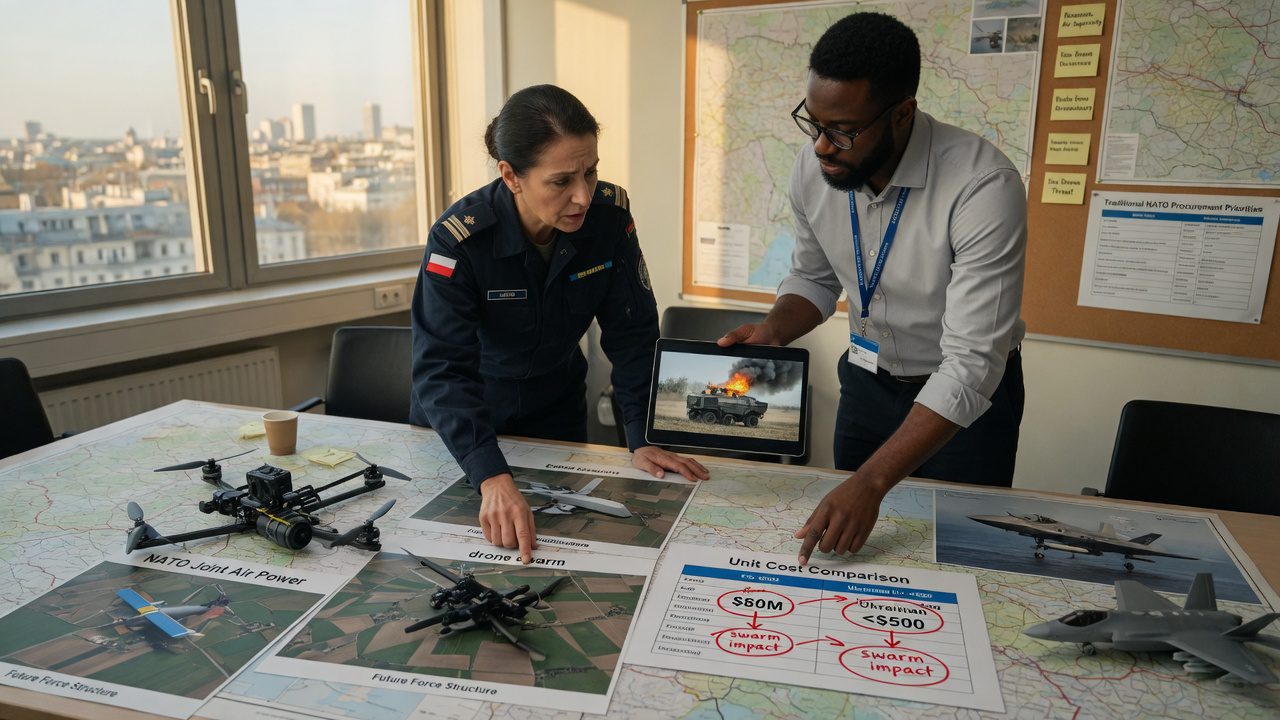
Ukraine’s Cheap Drones Upend NATO Military Plans
The ongoing conflict in Ukraine has dramatically illustrated how inexpensive drone technology can disrupt established military doctrines. NATO planners, long accustomed to investing billions in advanced fighter jets, armored vehicles, and precision munitions, now confront a stark reality: low-cost unmanned systems are reshaping battlefield dynamics and forcing a reevaluation of defense priorities.
Asymmetric Warfare Redefined
Ukraine’s innovative use of commercial off-the-shelf drones, modified FPV (first-person view) models, and maritime unmanned vessels has delivered outsized results against a numerically superior adversary. These systems often cost mere hundreds or thousands of dollars yet have neutralized equipment valued in the millions. Russian tanks, artillery positions, and naval assets in the Black Sea have fallen victim to strikes from drones assembled with parts sourced from global electronics markets.
This approach contrasts sharply with NATO’s traditional emphasis on high-end platforms. For decades, alliance members prioritized platforms like the F-35 stealth fighter or Aegis-equipped destroyers, systems designed for peer-level conflicts against sophisticated opponents. Ukraine’s experience demonstrates that massed, attritable drones can saturate defenses and achieve strategic effects without requiring equivalent technological sophistication.
Cost Comparisons Highlight the Shift
Consider the economics: A typical Russian T-72 tank carries a price tag exceeding $2 million, while an FPV drone capable of destroying it may cost under $500. Similarly, naval drones used to target the Black Sea Fleet represent a fraction of the expense of anti-ship missiles or submarines. Ukrainian forces have repeatedly shown that quantity and adaptability can overcome quality when paired with real-time intelligence and rapid iteration.
NATO defense budgets, already strained by inflation and competing priorities, must now account for this new calculus. Procurement strategies that favored small numbers of exquisite systems are giving way to discussions about scalable production of expendable munitions. Countries like the United States and United Kingdom have accelerated programs for loitering munitions and collaborative combat drones as a direct response.
Tactical Innovations from the Front Lines
Ukrainian operators have pioneered tactics that blend commercial technology with military application. Modified agricultural drones drop grenades on infantry positions, while sea drones packed with explosives have forced Russian warships to relocate from vulnerable ports. These methods leverage ubiquitous components such as DJI flight controllers and consumer batteries, enabling quick field repairs and modifications.
The success of these systems has prompted NATO to study Ukrainian training regimens and supply chains. Exercises now incorporate drone swarm scenarios, and alliance members are exploring joint development of standardized low-cost platforms. The emphasis has shifted from exquisite single-use weapons toward reusable or easily replaceable assets that can be produced at scale.
Implications for Alliance Strategy
This evolution challenges core assumptions within NATO’s defense planning. Long-range strike capabilities and air superiority remain important, yet the conflict reveals vulnerabilities in logistics, air defense saturation, and force protection against persistent low-altitude threats. Member states are revising concepts of operations to integrate drone countermeasures, electronic warfare suites, and distributed sensor networks.
Furthermore, the reliance on commercial components raises questions about supply chain resilience. Dependence on overseas electronics manufacturers creates potential chokepoints that adversaries could exploit. NATO is therefore investing in domestic manufacturing capacity for critical drone subsystems while encouraging innovation through public-private partnerships.
The Path Forward
As the war continues, the lessons from Ukraine will influence procurement decisions for years to come. Defense ministries across the alliance are reallocating funds toward drone research, autonomous systems, and counter-unmanned aerial vehicle technologies. The era of cheap, effective drones has arrived, compelling NATO to adapt or risk obsolescence on future battlefields.
Ultimately, Ukraine’s experience underscores that technological superiority no longer resides solely in expensive hardware. Adaptability, cost efficiency, and rapid innovation now define competitive advantage in modern conflict.
Leave a Reply