Category: Global Protocols

  • The Diplomatic Daycare: A Toddler’s Guide to Geneva Negotiations

    The Diplomatic Daycare: A Toddler’s Guide to Geneva Negotiations

    Picture the scene: a stately room in Geneva, filled with impeccably dressed diplomats speaking in hushed, serious tones. The fate of nations hangs in the balance. Now, picture the same room, but replace the diplomats with toddlers in ill-fitting suits. Suddenly, the complex geopolitical maneuvering in talks involving Ukraine, Russia, and Iran starts to look… familiar. It seems the core principles of international relations were perfected not in a war room, but on a Fisher-Price activity mat.

    The ‘It’s MINE!’ Protocol

    The cornerstone of any playground dispute, and apparently, any territorial negotiation. One country insists a piece of land is theirs because their great-great-great-grand-leader sat on it once. The other country insists it’s theirs because their flag looks better on it. This is the geopolitical equivalent of two four-year-olds fighting over the same red truck, despite a dozen identical blue trucks sitting in the toy box. The arguments escalate, voices get louder, and soon someone is threatening to hold their breath until they get their way.

    The Art of the Strategic Tantrum

    When negotiations stall, it’s time to deploy the ultimate weapon: the tantrum. This can take many forms. There’s the ‘I’m storming out!’ move, where a delegation dramatically leaves the Geneva diplomatic talks, promising never to return (until tomorrow). Then there’s the ‘sanction sulk,’ where one side declares the other can’t come to their birthday party or play with their economic toys anymore. It’s a high-stakes version of crossing your arms and refusing to share your Goldfish crackers until you get an apology.

    The ‘I’m Telling the UN!’ Gambit

    Every playground has an adult supervisor, and in global politics, that’s the United Nations. When all else fails, the go-to move is to run to the nearest authority figure and loudly proclaim, “He’s not following the rules!” This involves drafting strongly worded resolutions, pointing fingers during assemblies, and generally hoping the grown-up will put the other guy in a time-out. The effectiveness varies, but it’s a classic for a reason. So next time you see a headline about stalled talks in Geneva, just imagine a room full of world leaders who desperately need a nap and a juice box. Suddenly, it all makes a weird kind of sense.


  • From Rainforest to Red Square: The Poison Dart Frog’s Unlikely Spy Career

    From Rainforest to Red Square: The Poison Dart Frog’s Unlikely Spy Career

    Picture this: you’re scrolling through a nature documentary, admiring a jewel-toned frog no bigger than your thumb. It’s magnificent, a tiny testament to evolution’s flair for the dramatic. Now, picture a shadowy government agency’s requisition form: “Item: Untraceable neurotoxin. Quantity: One (1). Justification: Geopolitical tidying.” It seems impossible these two worlds would ever collide, yet here we are, discussing how a beautiful amphibian became an unwilling contractor in the murky business of international espionage.

    Meet Our Unwitting Accomplice

    The Poison Dart Frog isn’t malicious; it’s just very, very good at its job. Through a diet of specific ants and mites, it bio-accumulates one of the most potent neurotoxins known to science: Batrachotoxin. This isn’t your garden-variety poison. It’s the biological equivalent of finding a command-line prompt that grants root access to the entire nervous system. It works by forcing sodium ion channels to stay open, which basically sends every nerve cell into a permanent, chaotic “ON” state. Think of it as your body’s internal network suffering a denial-of-service attack from which it can never recover. The frog, of course, is immune. It’s not a bug; it’s a feature.

    The Geopolitical Help Desk Ticket

    So, why would a sophisticated state actor turn to the animal kingdom for its dirty work? The answer lies in the same logic that makes IT support ask if you’ve tried turning it off and on again: it creates a layer of frustrating obscurity. Using an exotic, naturally derived toxin offers several advantages:

    • Plausible Deniability: It’s much harder to trace a naturally occurring substance back to a specific government lab than a synthetic chemical with a clear manufacturing signature.
    • Forensic Chaos: Hospital toxicology screens are designed to find common poisons, not something brewed in the gut of an Amazonian amphibian. You have to know what you’re looking for, which is a huge head start for the perpetrators.
    • The Terror Factor: The sheer weirdness of it sends a message. It’s a demonstration of reach and creativity, a signal that perpetrators can access methods straight out of a spy thriller.

    This is precisely why, in the confusing aftermath of Alexei Navalny’s poisoning, the conversation briefly spiraled into a whirlwind of exotic possibilities. The confirmed culprit was a Novichok agent, but the initial speculation surrounding a potential Navalny poison dart frog toxin link highlights the playbook. The goal is to create a fog of war, where even the method of attack is a bewildering mystery.

    Nature’s Undocumented API

    Ultimately, this entire affair is a testament to humanity’s ability to find the most complicated solutions to its oldest problems. Nature spent millions of years perfecting a defense mechanism for a tiny creature, an elegant piece of biochemical engineering. And we, in our infinite wisdom, immediately saw its potential for political assassinations. The poison dart frog never asked to be part of this. It’s just sitting on a leaf, minding its own business, completely unaware that its personal firewall has been shortlisted for the next international incident. It’s perhaps the most absurd form of identity theft the world has ever seen.

  • Global Reboot: What Windows 11’s Update Chaos Teaches Us About International Relations

    Global Reboot: What Windows 11’s Update Chaos Teaches Us About International Relations

    We’ve all been there. You leave your computer for five minutes, and it chooses that exact moment to initiate a mandatory update. You return to a machine that has decided its Start Menu is now a purely decorative feature. This isn’t just a Tuesday in the office; it’s a microcosm of high-stakes global politics, a perfect example of how easily international technology disruptions can mirror diplomatic fiascos.

    The Glitch Heard ‘Round the World

    Consider the latest Windows 11 patch, let’s call it KB-123-OOPS. It was deployed with the promise of enhanced security and a feature that probably rearranges your desktop icons into abstract art. Instead, it broke VPNs, froze taskbars, and generally caused a global workforce to stare blankly at their screens. This is the technological equivalent of a world leader showing up to a summit and calling the host nation by the wrong name. It’s a small error with massive, cascading consequences. Suddenly, entire digital economies grind to a halt, not because of a cyberattack, but because of a well-intentioned but catastrophically buggy line of code.

    Diplomacy by Patch Notes

    What happens next is a delicate dance worthy of the United Nations. Microsoft can’t just say, “Our bad.” That would be too simple. Instead, we enter a phase of carefully managed crisis communication that looks suspiciously like international diplomacy.

    • The Initial Incident: A buggy update is released, destabilizing systems worldwide. (The diplomatic equivalent: A poorly worded trade policy is announced, tanking foreign markets.)
    • The Cautious Acknowledgment: A support page quietly appears, noting they are “investigating reports” of an “issue impacting some users.” (Translation: The ambassador has been summoned for a “frank and productive discussion.”)
    • The Rollback: An official tool is released to uninstall the offending update. This is the diplomatic walk-back, the official “clarification” of a statement that was perfectly clear in its initial, disastrous meaning. Everyone pretends this is a normal part of the process.
    • The Patch: A new update, KB-123-FIXED-IT-FOR-REAL-THIS-TIME, is pushed. This is the joint press conference, the signing of a revised accord, designed to fix the problem without ever fully admitting the scale of the original blunder.

    The ‘Have You Tried Turning It Off and On Again?’ Doctrine

    In both the world of IT and international relations, the real heroes are the people on the ground. They are the sysadmins brewing coffee at 2 a.m., pushing out the rollback script, and the junior diplomats working backchannels to smooth things over after a technical gaffe. They understand the most fundamental rule of complex systems: sometimes, you just need a reboot. These international technology disruptions remind us that whether you’re managing a fleet of PCs or a fragile peace treaty, the principles are the same: clear communication, a solid backup plan, and the humble acceptance that even the biggest players occasionally need to unplug it, wait ten seconds, and plug it back in again.

  • I Let ChatGPT Write My Love Texts and Got Ghosted: An AI Dating Advice Failure

    I Let ChatGPT Write My Love Texts and Got Ghosted: An AI Dating Advice Failure

    There I was, navigating the treacherous, beautiful waters of an international relationship. You know the drill: time zones that require advanced calculus, conversations over spotty Wi-Fi, and a deep, abiding respect for the person who invented airplane mode. In a moment of weakness, I turned to the modern oracle for help with a tricky conversation: ChatGPT. My thinking was simple: a machine with access to all human knowledge could surely draft one little text message, right? Spoiler alert: it could, and it was a glorious disaster.

    The Prompt That Broke the Connection

    The task was delicate. It was time for the ‘What are we?’ talk, but with the added complexity of a few thousand miles. I fed my situation to the AI, asking for a message that was clear, confident, and emotionally resonant. What I got back was the emotional equivalent of a corporate earnings report. It was a perfectly structured, grammatically flawless paragraph that suggested we ‘synergize our relational objectives’ and ‘establish key performance indicators for our future partnership.’ It was a masterpiece of logical efficiency that had all the romantic charm of a software license agreement.

    Silence of the LANs

    Against my better judgment, I sent a slightly-less-robotic version of it. The response was immediate and deafening: silence. Not just a delayed reply, but a full-on digital tumbleweed rolling across our chat window. I hadn’t been ghosted by a person; I had been ghosted by a protocol error. My partner didn’t receive a message from me; they received a dispatch from a well-meaning but clueless robot who thinks love is a problem to be optimized. The AI’s attempt to remove human error had, in fact, removed the human.

    The Human Element is a Feature, Not a Bug

    And that’s when it hit me. The very things the AI tried to eliminate—the awkward pauses, the clumsy phrasing, the vulnerability of saying ‘I miss you’ instead of ‘I am registering a deficit of your presence’—are the entire point. Romance isn’t a clean system to be debugged. It’s messy, illogical, and deeply human. Trust isn’t built on perfectly optimized communication; it’s built on seeing each other’s weird, imperfect, authentic selves. So, what did I learn from my AI dating advice failure? A few things:

    • AI is a fantastic tool for writing code or summarizing articles, not for whispering sweet nothings.
    • Your authentic, slightly-nervous voice is infinitely more attractive than a machine’s sterile perfection.
    • The most important global protocol for connection isn’t TCP/IP; it’s just being a real person.

    Needless to say, I sent a follow-up message: ‘Sorry about that weird text. My robot assistant is on a power trip. You up?’ The reply came instantly. Connection re-established.

  • From Poison Darts to Exploding Cigars: A History of Bizarre Political Plots

    From Poison Darts to Exploding Cigars: A History of Bizarre Political Plots

    In the hallowed halls of international espionage, one imagines sleek, silent professionals executing flawless plans. The historical record, however, often reads more like a series of rejected gadget pitches from a B-movie. The history of international political assassinations is less about surgical precision and more about comical over-engineering, a field where the most complex solution is always preferred over the simplest one. It’s a masterclass in what happens when the R&D department has too much budget and not enough adult supervision.

    The Artisanal Era: When Your Pen Was Mightier (and More Poisonous)

    Before the digital age, bespoke was best. Consider the infamous Bulgarian umbrella, a device designed to deliver a tiny ricin pellet. On paper, it’s ingenious. In practice, it’s a solution desperately searching for a problem that couldn’t be solved by, say, a discreet needle. It’s the espionage equivalent of building a Rube Goldberg machine to butter your toast. You have to admire the commitment to the theme, but you also have to wonder about the project review meeting where someone said, “Yes, an umbrella. In London. That’s not at all conspicuous.”

    The Cold War Brainstorming Session Gone Wrong

    The Cold War was the undisputed golden age of absurd assassination plots, with Fidel Castro as the apparently indestructible star of the show. The CIA’s attempts on his life weren’t just plans; they were performance art pieces that consistently failed the most basic user acceptance testing. A few highlights from the declassified backlog:

    • The Exploding Cigar: A classic case of overthinking. The logistics are a project manager’s nightmare. Does he have a light? Is it the right brand? What if he offers it to a friend? The entire operation hinges on variables completely outside the team’s control.
    • The Poisoned Wetsuit: The plan was to dust a diving suit with a fungus designed to cause a chronic skin disease. This feels less like a state-sponsored hit and more like a convoluted prank pulled by a disgruntled quartermaster. The sheer passive-aggressiveness is almost admirable.
    • The Exploding Seashell: This involved rigging a particularly beautiful conch shell with explosives, hoping the target, an avid diver, would simply pick it up. This moves beyond bad planning and into the realm of wishful, almost romantic, thinking.

    Modern Methods: The User Interface is a Doorknob

    You’d think we’d have streamlined the process by now, but the tradition of bizarre execution continues. More recently, the methods have become chemically sophisticated but no less prone to slapstick error. Applying a military-grade nerve agent to a front door handle is the 21st-century update, turning a common object into a deadly delivery system. But like any poorly designed UI, it’s prone to unintended clicks and collateral damage, leading to a global diplomatic incident instead of a clean getaway. It turns out that when your weapon of choice is invisible and indiscriminately persistent, the bug report list gets very long, very quickly.

    Ultimately, the long and strange history of these plots is a testament to human ingenuity—and its frequent and comical failure. For every successful operation, there are dozens that sound like they were cooked up after a long lunch meeting. It’s a stark reminder that even in the world of high-stakes power plays, the most dangerous weapon is often just a terrible idea.

  • White House Ballroom Drama: When Home Renos Go Global

    White House Ballroom Drama: When Home Renos Go Global

    We’ve all been there. Staring at two nearly identical paint swatches—’Whispering Fawn’ and ‘Gentle Ghost’—while a relationship hangs by a thread. Now, imagine that instead of your partner, you have to please 200 years of history, the entire electorate, and several nuclear-armed geopolitical rivals. Welcome to the high-stakes world of presidential home renovation, the ultimate expression of what we’ll call international political aesthetics diplomacy. It’s the art of saying ‘we are a formidable, yet approachable, global power’ with a well-chosen portico.

    The Ultimate Open-Concept Floor Plan: 1800 Edition

    When the White House was first built, the project brief was essentially ‘build a house for a president.’ The problem? No one knew what that looked like. The design had to thread a needle: be grander than a governor’s mansion but less gaudy than a European palace. It had to project democratic ideals, which apparently meant a lot of stately white columns. This wasn’t just architecture; it was nation-branding. The United States was the new kid on the block, and its headquarters couldn’t look like it was built from a flat-pack box. Every cornice and pediment was a carefully coded message to the world: ‘We’re here, we’re stable, and please take our currency seriously.’

    That Time a Balcony Broke the Internet (Almost)

    Fast forward to 1947. President Harry Truman, in a move that feels deeply relatable to anyone who’s ever thought ‘you know what this place needs?,’ decided to add a balcony to the South Portico. The public outcry was immediate. Critics called it an eyesore and claimed it ruined the building’s classical lines. It was the architectural equivalent of a software update nobody asked for, a feature that cluttered the clean UI of American democracy. But in the post-WWII era, America was a new kind of world leader. The Truman Balcony, a modern, functional addition for the First Family, subtly signaled a shift—a willingness to update the old system, to step out into the open, even if the critics preferred the original design specs.

    The Camelot System Restore: Aesthetics as Foreign Policy

    Perhaps the most famous renovation was Jacqueline Kennedy’s historical restoration project. When she arrived, she found the White House decorated with furniture that had all the historical gravitas of a mid-range department store. Her mission: a full system restore. She didn’t just redecorate; she curated a museum. This wasn’t about picking nice curtains. It was a masterclass in soft power during the Cold War. As the Soviet Union was launching satellites, the Kennedys hosted televised tours showcasing priceless American antiques. The message was clear: we don’t just have power, we have culture, history, and impeccable taste. It was international political aesthetics diplomacy at its finest, proving that a well-placed divan can be as persuasive as a treaty.

    So the next time you’re stuck in a home improvement project, agonizing over cabinet hardware, just remember: it could be worse. Your choice of backsplash isn’t likely to be interpreted as a foreign policy statement. Probably.

  • When Lasers Ground Planes: A Guide to International Tech Diplomacy Mishaps

    When Lasers Ground Planes: A Guide to International Tech Diplomacy Mishaps

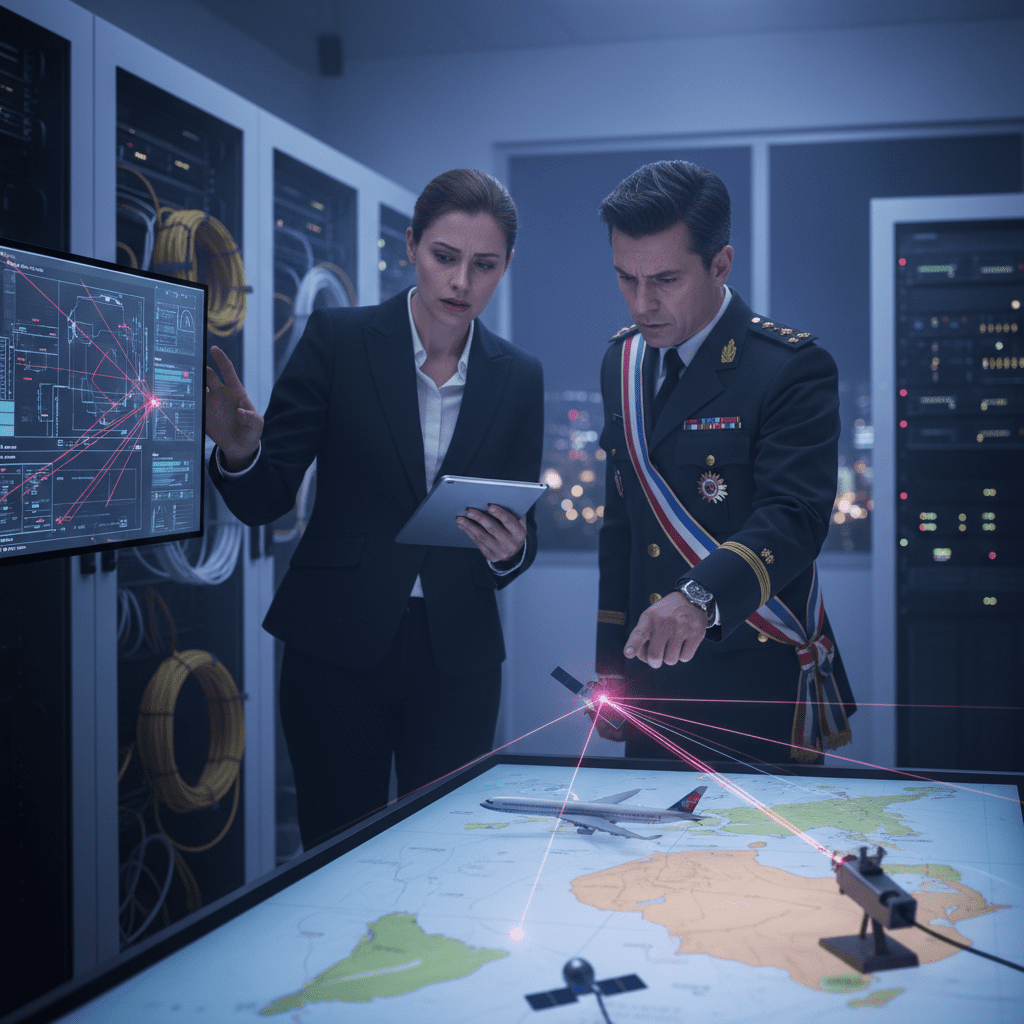
    There’s a beautiful, terrifying simplicity to the story of a commercial flight being grounded because someone on the ground pointed a laser at it. To the person holding it, it’s a presentation tool, a cat toy, a tiny red dot of mild amusement. To the pilot, it’s a cockpit-blinding threat vector. It’s the same piece of technology, viewed through two completely different operational manuals. This, in a nutshell, is the story of most international technology mishaps in diplomacy. It’s less about malice and more about one party thinking ‘cat toy’ while the other is screaming ‘imminent threat.’

    The biggest breakdowns in global tech collaboration don’t come from sophisticated cyberattacks; they come from the soul-crushing, bureaucratic equivalent of forgetting the Wi-Fi password. These are the moments where billion-dollar initiatives are foiled by the same kind of problems that make you call your local IT help desk.

    The Museum of Diplomatic Tech Fails

    Imagine a G7 summit where progress grinds to a halt. The cause? Not a contentious trade policy, but the fact that one delegation brought laptops with Type G plugs and the host nation’s ancient, beautiful statehouse is exclusively equipped with Type F sockets. The next few hours are a frantic, high-stakes scavenger hunt for universal adapters, a pursuit far more intense than any geopolitical negotiation. This isn’t a failure of statecraft; it’s a failure to check the technical rider.

    These mundane glitches happen on a grand scale:

    • The Firewall of Silence: A joint climate research initiative between two nations stalls. Country A can’t access the shared data portal. They assume Country B is stonewalling. In reality, Country B’s overzealous state firewall has simply classified Country A’s entire IP range as ‘Suspicious,’ likely because someone tried to stream a football match three years ago. The diplomatic freeze is caused by a firewall rule that hasn’t been updated since dial-up was a thing.
    • The 50MB Email Attachment That Sank a Treaty: Picture this: a critical trade addendum, painstakingly crafted into a 50-megabyte PDF with high-resolution charts, is emailed. The sender’s system says ‘Sent.’ The receiver’s ancient email server, with its 20MB attachment limit, silently rejects it. For two days, one side waits for a response while the other thinks they’re being ignored. The resulting diplomatic friction could have been avoided by a simple file-sharing link.
    • The ‘Proprietary’ Software Standoff: A multinational defense coalition agrees to a shared communications platform. It’s a great idea, until they discover the platform was built by a contractor who used a proprietary video codec. Half the coalition can’t join the video calls, turning top-secret strategy sessions into a disjointed conference call where every other sentence is, “Can you hear me now?”

    The core issue is a communication gap that mirrors the laser pointer scenario. The diplomats agree on the ‘what’—shared data, secure communication, a successful summit. They leave the ‘how’ to the technicians, who themselves are bound by their own national protocols and assumptions. No one stops to ask the boring, crucial questions. What file format? What plug type? What’s your firewall’s policy on inbound traffic from… well, us? We’re not dealing with masters of espionage, but with the consequences of not having a project manager who insists on a technical kick-off meeting. At the end of the day, the most effective tool in international relations might not be a treaty, but a well-written IT onboarding document.

  • When Global Policy Overheats the Local Server: An Immigration Story

    When Global Policy Overheats the Local Server: An Immigration Story

    Imagine you’re the sysadmin for a small, stable, and predictable network. Let’s call it ‘SmallTownUSA.’ The user base is consistent, the uptime is great, and the biggest ticket in the queue is from the mayor, who can’t find the ‘any’ key. Then one morning, without warning, a massive, undocumented patch from Corporate gets force-pushed to your server. The patch is called ‘ICE-RAID_v2.4,’ and it doesn’t come with a readme file. The entire network is about to experience a catastrophic failure, and your only tool is a pot of lukewarm coffee.

    The Unscheduled API Call

    From a systems perspective, a federal raid in a small town is the ultimate unscheduled API call. The local network—the sheriff’s department, the city council, the town’s single traffic light—receives a flood of high-priority requests it was never designed to handle. Suddenly, the town clerk, whose biggest IT problem is usually a paper jam, is expected to interface with a multi-billion dollar federal database that probably still runs on COBOL. It’s a classic compatibility issue. You’re trying to plug a quantum computer into a switchboard operated by a nice lady named Ethel.

    Error 404: Local Economy Not Found

    The primary function of this federal script appears to be removing specific ‘user accounts.’ The problem is, these aren’t just isolated accounts; they are deeply integrated dependencies for the entire local operating system. You can’t just batch-delete a third of the workforce at the local processing plant and expect the ‘LocalEconomy.exe’ module to keep running. The script doesn’t account for the fact that the deleted ‘user’ was also the only person who knew how to fix the industrial dough mixer, which is critical for the annual town bake sale. The result is a cascade of system-wide failures, from supply chain lags to a sudden, sharp decline in demand for pot roast at the local diner.

    When the Patch Creates More Bugs

    The stated goal of any system patch is to improve stability and security. But this particular patch seems to introduce more bugs than it fixes. We’re talking about a denial-of-service attack on the town’s social fabric, corrupted data tables in the community trust index, and a catastrophic failure of the ‘Sense of Normalcy’ kernel. The aftermath isn’t a clean, optimized system; it’s a town full of broken links, orphaned processes, and a desperate need for a system restore from a backup that no one ever made. Maybe the next update could come with a beta test, better documentation, and, for heaven’s sake, a simple confirmation prompt before executing.

  • When Nations Get Ghosted: Europe’s Awkward Munich Reunion

    When Nations Get Ghosted: Europe’s Awkward Munich Reunion

    The annual Munich Security Conference is supposed to be the geopolitical equivalent of a corporate trust-fall exercise. World leaders gather, sip suspiciously beige coffee, and reaffirm that, yes, they’ve still got each other’s backs. But this year’s get-together had the distinct vibe of a group project where the main contributor just changed their status to “offline” and nobody knows if they’re coming back.

    The Read Receipt That Never Came

    The source of this international awkwardness? A series of digital smoke signals from across the Atlantic, most notably former President Trump’s criticism of NATO members’ defense spending. It was the diplomatic equivalent of receiving a text that says, “We need to talk about your contributions to our shared data plan.” Suddenly, Europe is left staring at the screen, re-reading old messages, and wondering if this long-term partnership is about to become an open relationship.

    You could almost hear the frantic internal monologue in the conference halls: “Did we do something wrong? We thought we were exclusive! Should we have paid for the premium tier?” It’s less about global Armageddon and more about the bureaucratic nightmare of realizing your primary sysadmin might be revoking your privileges.

    The Troubleshooting Checklist

    Faced with a potential service disruption, European leaders did what any of us would do: they started frantically troubleshooting. Their collective to-do list seems to be a mix of technical and emotional support, including:

    • Running a budget diagnostic: A frantic search for spare change in the couch cushions to meet that 2% defense spending KPI.
    • Checking the user agreement: Dusting off the NATO charter to see what Article 5’s service-level agreement *really* guarantees.
    • Developing a local backup: The sudden, urgent chatter about “European strategic autonomy” is the geopolitical version of buying an external hard drive after your cloud provider changes its terms of service.

    It’s a scramble, but a familiar one. It’s the panic that sets in when you realize your entire digital life is tied to one password you can’t quite remember, and the “Forgot Password” link is broken.

    An Upgrade, Not an Apocalypse

    Ultimately, the Munich conference wasn’t a funeral; it was a painfully awkward, mandatory IT meeting. Europe is being forced to confront its own dependencies and debug a system that’s been running on legacy code for decades. Maybe this is the push it needed to finally develop its own standalone security app instead of just being a user on someone else’s platform. It’s messy, uncomfortable, and involves a lot of passive-aggressive communiqués, but hey, that’s how you get a system upgrade.

  • AI Apocalypse or Hype Machine? Decoding the Global Panic About Jobs and the Economy

    AI Apocalypse or Hype Machine? Decoding the Global Panic About Jobs and the Economy

    Open any news app and you’d think we’re living in the first five minutes of a sci-fi blockbuster. Headlines scream about an impending AI apocalypse, where robots will not only steal your job but also probably use your stapler without asking. The panic is palpable, echoing in boardrooms and government halls worldwide. But is this a genuine five-alarm fire for the ai disruption job market global economy, or is the tech industry just yelling ‘fire’ to sell us all shiny new AI-powered fire extinguishers?

    The Official Panic-o-Meter: Is It Y2K All Over Again?

    Let’s be real: the concern isn’t entirely baseless. Powerful AI models are changing how we work. But the breathless warnings of mass unemployment sound suspiciously familiar. Remember when calculators were supposed to make mathematicians obsolete? Or when spreadsheets were destined to replace every accountant on Earth? Instead, mathematicians got to focus on cooler problems, and accountants got a tool that made their jobs less about manual number-crunching and more about, well, slightly more advanced number-crunching. This isn’t the first technological rodeo. The current ai disruption feels less like a hostile takeover and more like the entire global economy is on a chaotic conference call, with every world leader trying to figure out who’s supposed to be taking minutes.

    Following the Money: The Hype Machine’s Business Model

    It’s worth noting that many of the loudest voices warning about AI’s world-altering power belong to the very companies building it. It’s a marketing masterstroke, really. Step 1: Create a technology so powerful it could theoretically destabilize the job market. Step 2: Warn everyone about the potential chaos. Step 3: Sell them the AI-powered ‘solution’ to manage it. It’s like a baker warning you about the dangers of a sugar rush while handing you a freshly glazed donut. The fear is a feature, not a bug, designed to get companies and countries to invest heavily before they get ‘left behind’.

    Your Anti-Apocalypse Action Plan

    So, should you be converting your savings to canned goods or just updating your LinkedIn profile? We suggest the latter. Instead of panicking, here’s a more productive to-do list:

    • Treat AI Like a Super-Confident Intern: It’s brilliant at research and drafting emails, but it has a tendency to make things up with startling confidence. Let it do the grunt work, but for heaven’s sake, double-check its sources before you present them to your boss.
    • Double Down on Being Human: AI is terrible at office politics, empathy, creative problem-solving, and knowing when a meeting could have been an email. Your ability to navigate complex human emotions is now a premium, in-demand skill.
    • Learn the Lingo: You don’t need a PhD in machine learning, but understanding the basics helps you separate genuine innovation from buzzword-laden nonsense. It’s the best defense against the hype machine.

    Ultimately, the ai disruption is real, but the robot uprising is probably on backorder. The future of work isn’t about humans versus machines. It’s about humans who know how to use machines to finally get out of doing their expense reports. And that, truly, is a disruption to the global economy we can all get behind.