
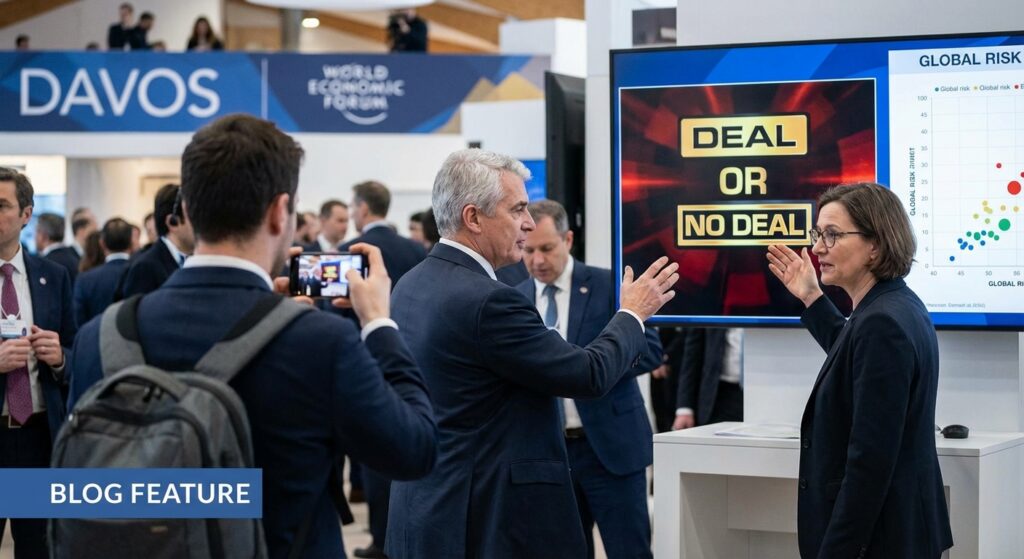
Picture the scene: the stage is lit, the tension is palpable, and a row of identical briefcases holds fates unknown. No, this isn’t a daytime game show rerun; it’s the World Economic Forum in Davos. The contestants are world leaders, the host is the relentless march of globalization, and the grand prize is, well, not triggering an immediate global recession. For a few days every year, the snowy peaks of Switzerland become the set for the world’s most consequential game of ‘Deal or No Deal’.
Our Star Contestant and His Briefcase
Every good game show needs a charismatic star. Enter former President Trump, whose signature ‘art of the deal’ approach to international relations turned every negotiation into a potential season finale. While other leaders clutched their policy briefs like nervous contestants hoping to avoid the 1-cent case, Trump’s strategy was to keep everyone guessing. Would he take the banker’s offer of a multilateral agreement, or would he go for broke on a bilateral trade deal that could be worth trillions… or nothing?
What’s Actually in Those Briefcases?
The stakes at Davos are slightly higher than a new car or a vacation package. The briefcases contain the very architecture of our globalized world. When a leader ‘opens a case’, they’re not just revealing a number; they’re revealing a policy decision with massive ripple effects. The board might look something like this:
- Briefcase #5: A new series of trade tariffs. Value: -$200 Billion and a global supply chain migraine.
- Briefcase #12: A surprise climate accord. Value: A slightly less melty planet, but the Banker’s offer is a ‘modest’ carbon tax you have to pass.
- Briefcase #22: A bilateral handshake deal. Value: Potentially huge for two countries, but makes everyone else in the room awkwardly check their phones.
- Briefcase #1: The dreaded global recession. Value: Basically negative infinity. Avoid at all costs.
The Banker Is On Line One
In this version of the game, ‘The Banker’ is a coalition of sober-suited economists from the IMF and WTO. Their offers are always the same: a 700-page document full of carefully worded compromises that makes everyone equally, mildly unhappy. It’s the sensible beige sedan of global policy. The core drama of Davos-style international relations is whether leaders, particularly figures like Trump, will take the safe, boring, multilateral deal from The Banker or risk it all for a spectacular win. It’s a clash between predictable stability and high-stakes showmanship.
So as we watch the highlights, it’s easy to get caught up in the spectacle. But unlike a TV show, we can’t just change the channel if we don’t like the outcome. We’re all in the studio audience, hoping the final briefcase contains something better than a lifetime supply of economic uncertainty.