
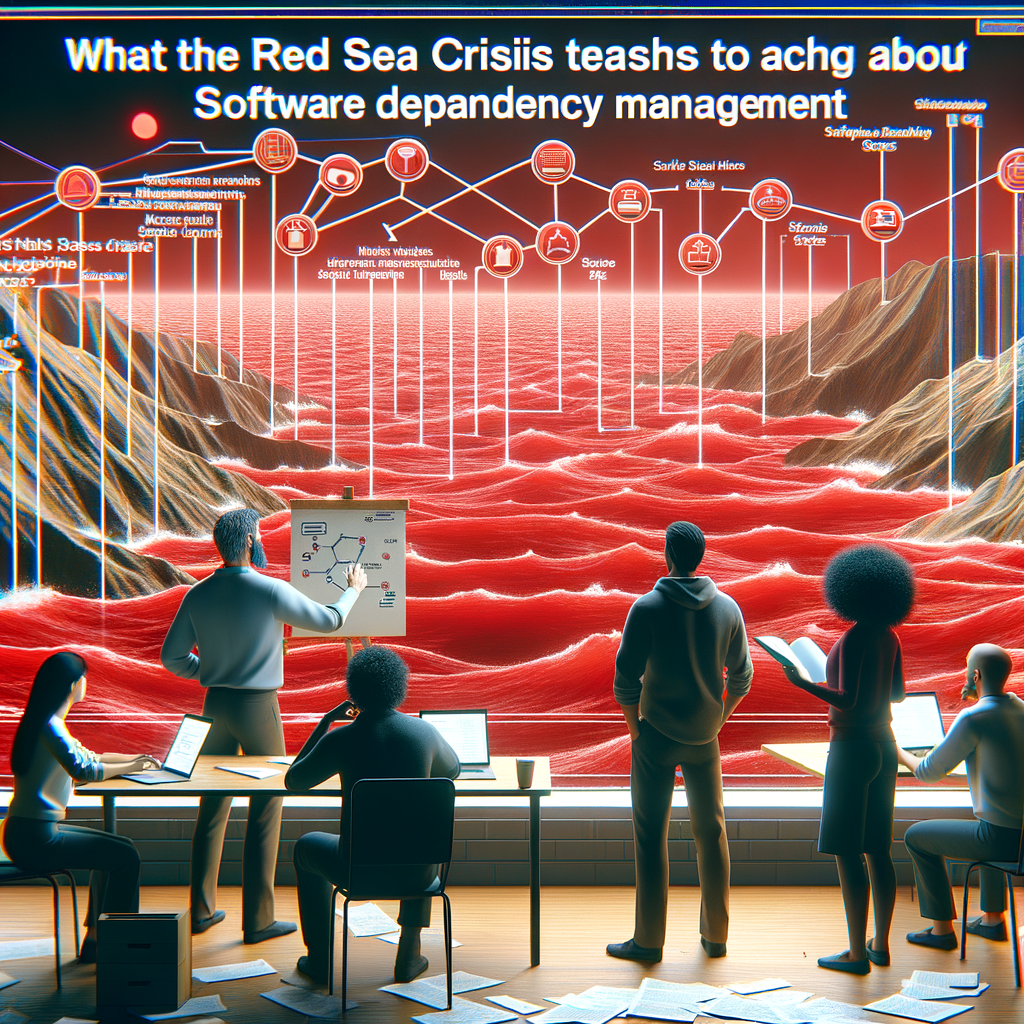
You’re watching the news, shaking your head as Houthi rebels single-handedly reroute global maritime trade through the Red Sea. A few container ships get targeted, and suddenly, 12% of the world’s commerce has to take the scenic route around Africa. It feels absurd, distant, and geopolitical. But then you get a Slack alert: the production build is failing. After three hours of frantic debugging, you trace it to a seven-year-old, two-line npm package whose maintainer just decided to unpublish everything in a fit of pique. Sound familiar? A single, obscure weak point, whether it’s the Bab el-Mandeb strait or `is-even@0.1.1`, can bring a multi-trillion-dollar system to a grinding halt. Welcome to dependency hell. It’s the Red Sea crisis, but for your `node_modules` folder.
The Unsettling Parallel Between Shipping Lanes and `package.json`
The core problem is identical: we’ve built incredibly efficient, complex global systems on top of a few critical, narrow passages that we don’t control. In shipping, it’s a strait. In software, it’s a popular open-source library maintained by one person in their spare time. When that single point of failure is compromised—by pirates, politics, or a programmer who’s just tired of getting zero-dollar donations—the cascade begins. Your just-in-time delivery of microservices grinds to a halt, and your sprint velocity plummets as you try to figure out why a function that formats dates suddenly requires a cryptocurrency miner.
Your Survival Guide to Navigating Dependency Chaos
You can’t personally negotiate a ceasefire in the Middle East, but you can secure your own software supply chain. Stop being a passive consumer floating on the whims of the open-source ocean and start being the captain of your own vessel. Here’s how:
- Become Your Own Port Authority: Vendor Everything. The public npm registry is a bustling, chaotic port of call. It’s convenient, but you have no idea if the crane operator is going on strike. The solution? Bring the port in-house. Use a private registry like Artifactory, Nexus, or GitHub Packages to host vetted, approved versions of your dependencies. This turns a treacherous public waterway into your own placid, well-guarded canal. You decide what comes in and out, and no rogue maintainer can sink your battleship.
- Laminate Your Navigational Charts: Lockfiles are Non-Negotiable. A `package-lock.json` or `yarn.lock` file isn’t a suggestion; it’s a legally binding contract with your build server. It’s the exact manifest of every crate on your ship, down to the last nut and bolt. It ensures that the build that worked on your machine yesterday will work on the CI server tomorrow, preventing the dreaded “but it works on my machine!” scenario. Allowing floating versions (`~` or `^`) for critical dependencies is like telling your navigator to “just aim for Africa-ish.”
- Scan for Pirates: Automate Your Security. You wouldn’t sail through the Gulf of Aden without a lookout. So why would you ship code without scanning for vulnerabilities? Integrate tools like Snyk, Dependabot, or Trivy directly into your CI/CD pipeline. These are your automated maritime patrols, scanning the horizon for known pirates (CVEs) and alerting you before they have a chance to board your production server and demand a ransom.
- Don’t Hire a Supertanker to Deliver a Pizza: Question Every Dependency. We’ve all been there. You need a simple function, and you find a package that does it. Five minutes later, you’ve added 3MB and 75 transitive dependencies to your project just to pad a string. Before you type `npm install`, ask yourself: “Can I write this myself in ten minutes? Do I really need an entire shipping fleet for this one small package?” A smaller dependency surface area means fewer canals to navigate and fewer potential blockades to worry about.
From Geopolitics to `git push`
The lesson from the Red Sea is a stark one for software engineers. Our world runs on fragile, interconnected supply chains, and whether the cargo is crude oil or JavaScript bundles, the risks are the same. Proactive software dependency management isn’t just about clean code or faster builds; it’s a fundamental practice of risk mitigation. It’s about ensuring your project doesn’t get stuck sideways in a canal because someone you’ve never met, halfway across the world, decided to make a point. So build your ports, chart your courses, and for goodness sake, check what’s actually in the container before you load it onto the ship.