
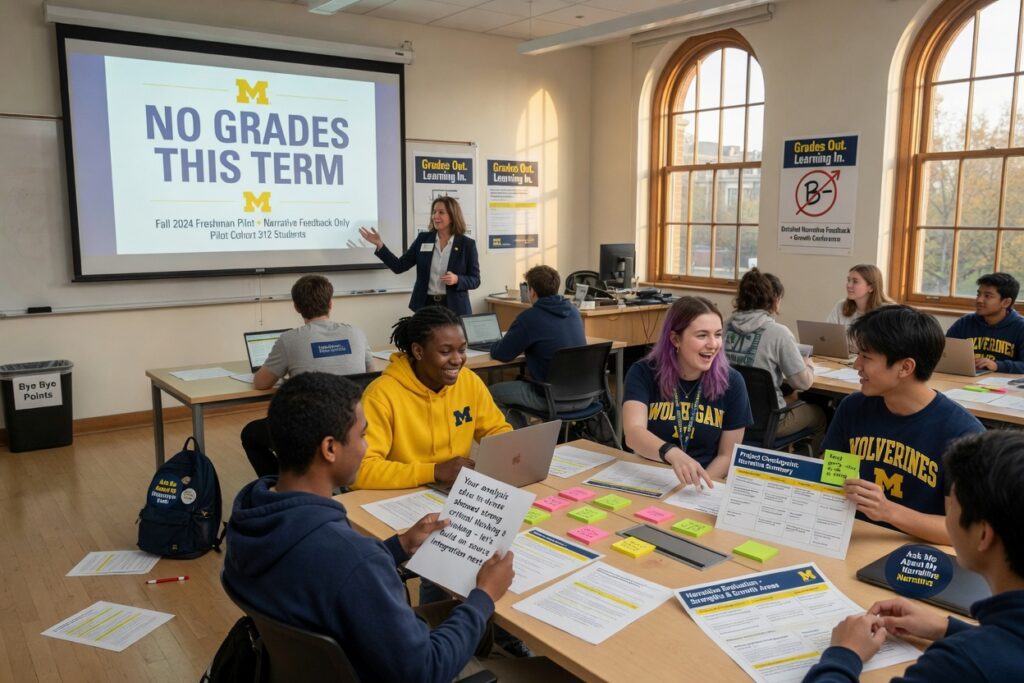
Remember those endless all-nighters fueled by bad coffee and worse policy tweaks? The University of Michigan’s move to let freshmen go pass/fail is just the latest bureaucratic patch in a never-ending loop of trying to debug student stress without ever refactoring the whole system.
Why Michigan Is Flipping The Switch On Freshman Grading
Starting this fall, first-year students at Michigan can opt for a pass/fail setup in many courses, ditching the traditional A-through-F infrastructure that has powered academic anxiety since the days of punch cards. It’s framed as stress relief, but it feels suspiciously like IT departments rolling out yet another update that promises to fix everything while creating new support tickets.
The Policy Loop Every Parent And Grad Knows Too Well
Schools keep circling the same track: add counseling apps, tweak deadlines, then tinker with grading scales when the real issue is the underlying data model of constant evaluation. Michigan’s freshman fix pokes fun at this by treating grades like outdated on-prem servers that nobody wants to migrate, even though everyone complains about the downtime they cause to mental health.
Tech And Data Infrastructure Implications
From an IT perspective, moving to pass/fail simplifies the student performance database, reducing the granularity that feeds into analytics dashboards, recommendation engines, and even scholarship algorithms. Less granular data means fewer fields to secure, potentially lowering the attack surface for breaches, but it also breaks legacy reporting tools that assume fine-tuned GPA inputs for everything from admissions to employer portals.
- Cloud-based learning platforms may need schema updates to handle binary outcomes instead of weighted scores.
- Data centers running education software could see lighter query loads, freeing cycles for actual teaching tools rather than stress-tracking metrics.
- Policy shifts like this highlight how universities treat academic records as critical infrastructure that resists change until user complaints hit critical mass.
Real-World Impact On Students And The Industry
Graduates entering tech will recognize the pattern: another well-intentioned policy that trades detailed feedback for reduced cognitive load, much like switching from on-prem monitoring to simplified SaaS alerts. It eases freshman year pressure but risks leaving gaps in the data that grad schools and employers rely on, forcing everyone downstream to build workarounds. In the end, Michigan’s experiment proves that sometimes the quickest fix for a bloated system is just turning the complexity dial down to pass or fail.