
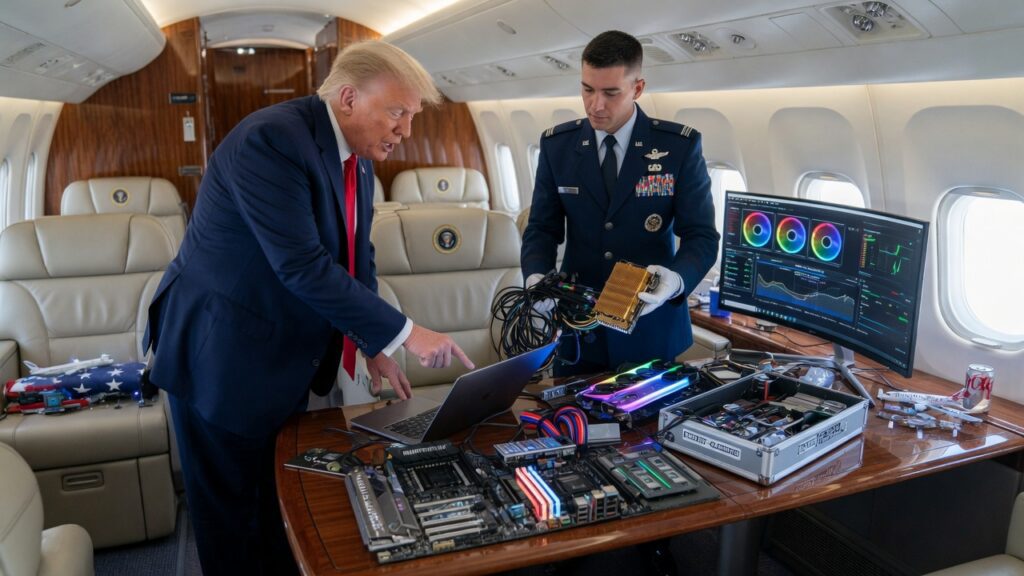
The announcement that the Trump administration plans to max out Air Force One upgrades draws a direct parallel to the familiar pattern of endlessly customizing high-end personal computing hardware, where each new feature addition extends project timelines and inflates budgets without clear endpoint criteria. This approach to presidential aircraft modernization underscores recurring challenges in government technology procurement, where incremental additions to avionics, communications systems, and defensive technologies mirror the over-specification common in enterprise IT deployments.
The Upgrade Cycle in Government Technology Projects
Air Force One operates as a mobile command and control platform reliant on integrated secure networks, encrypted data links, and hardened onboard computing infrastructure. Proposals to layer additional capabilities—such as enhanced satellite connectivity, advanced radar countermeasures, and expanded onboard data processing—echo the iterative hardware refresh cycles seen in federal data centers and cloud migration initiatives. Without strict milestone gates, these projects risk entering prolonged loops of feature expansion that delay operational readiness.
Security Architecture Considerations
Maxing out upgrades on the presidential jet directly affects the cybersecurity posture of national leadership assets. Additions to onboard systems must undergo rigorous supply chain validation and zero-trust architecture implementation to prevent vulnerabilities in the aircraft’s isolated networks. Historical federal IT programs demonstrate that unchecked expansion of endpoints and data pathways often introduces new attack surfaces, requiring sustained investment in intrusion detection and hardware root-of-trust mechanisms.
Infrastructure Parallels and Cost Impacts
The Air Force One overhaul shares structural similarities with large-scale federal infrastructure initiatives, including data center consolidations and secure communications backbone upgrades. Each added capability increases not only acquisition costs but also long-term sustainment requirements for specialized maintenance crews, spare components, and certification processes. Policy analysts note that such expansions frequently exceed initial appropriations by factors observed in other defense technology programs, shifting resources away from baseline operational priorities.
- Integration of new sensor arrays demands updated electromagnetic hardening standards.
- Expanded onboard servers require enhanced power and cooling redundancy systems.
- Secure communications upgrades necessitate parallel advancements in ground station infrastructure.
Strategic Policy Recommendations
To mitigate risks associated with open-ended upgrade cycles, oversight bodies should enforce capability baselines tied to threat assessments rather than feature accumulation. Aligning Air Force One modernization with established federal cybersecurity frameworks, such as those governing critical infrastructure protection, would provide measurable benchmarks for completion. This disciplined approach reduces the probability of scope creep while maintaining the technological edge required for executive transport operations.