
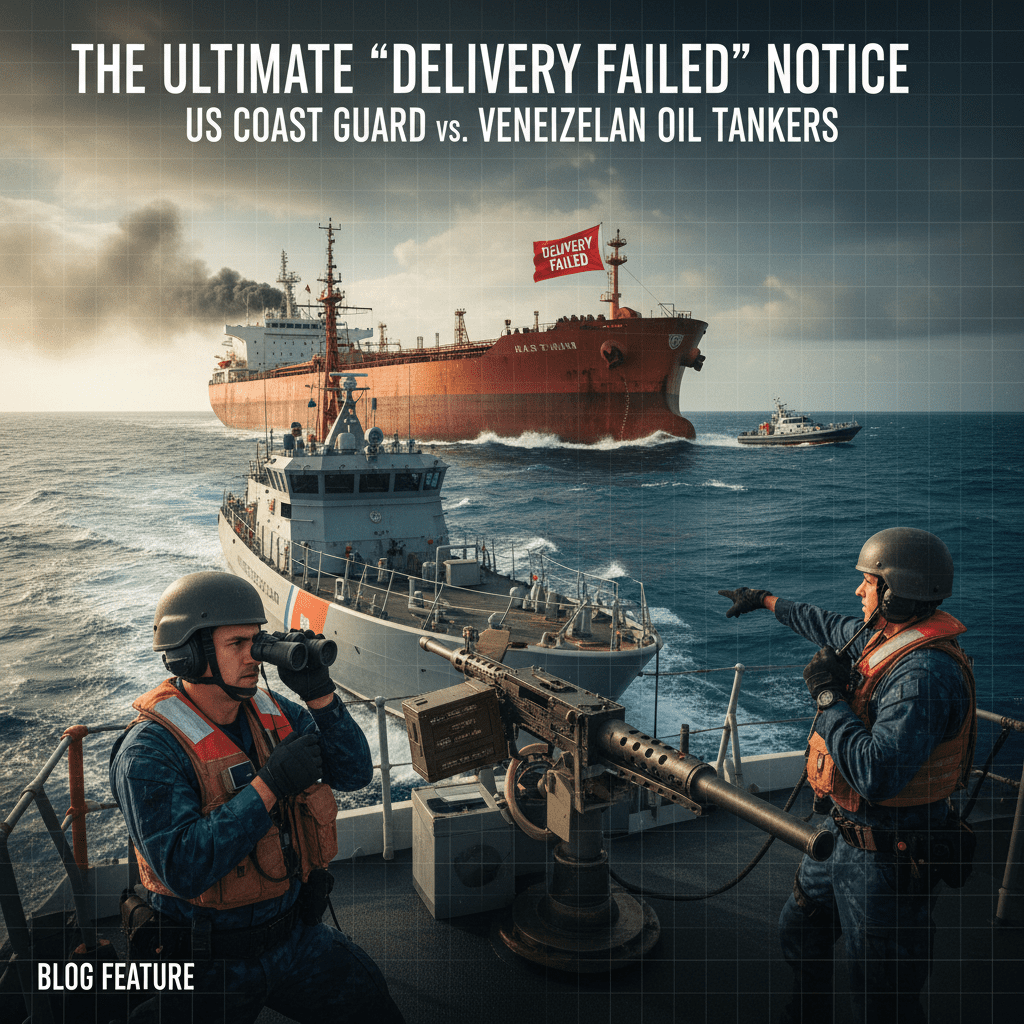
Picture a police chase. You’re probably thinking of screeching tires and helicopters. Now, replace the sports car with a vessel the size of three football fields that tops out at a brisk 15 knots, and replace the police cruiser with another, slightly faster boat. This isn’t a blockbuster movie; it’s the bizarre, slow-motion ballet of a US Coast Guard interception of a Venezuelan oil tanker, and it’s the new face of international diplomacy. It’s less ‘Fast & Furious’ and more ‘Glacially Paced & Mildly Annoyed.’
Sanctions: The Global Firewall Rule
At its core, this maritime drama is a physical manifestation of a digital problem. Think of international sanctions as a giant, global firewall. A country’s entire shipping operation is added to a blocklist, and any attempt to deliver goods is met with a ‘Connection Timed Out’ error. But since you can’t just send a 403 Forbidden error to a million-barrel oil tanker, you have to dispatch the system administrators of the sea: the Coast Guard.
The process is a masterclass in procedural patience:
- The Ping: It all starts with data. Using satellite imagery and Automatic Identification System (AIS) trackers, authorities watch for a digital blip heading in the wrong direction. It’s the world’s most expensive game of Where’s Waldo.
- The Polite Hail: There’s no dramatic ramming. Instead, there’s a very formal radio call. It’s the maritime equivalent of an automated email saying, “We’ve noticed unusual activity on your account.”
- The Escort Service: If the tanker doesn’t turn around, the Coast Guard cutter begins a very close, very persistent escort. It’s like having your IT manager stand over your shoulder all day to make sure you’re not trying to access blocked websites. Awkward, but effective.
Diplomacy at 10 Knots
So why all the nautical fuss? Why not just send a strongly worded letter? Because a vessel on the horizon is a message that can’t be sent to spam. It’s a physical assertion of a digital rule, a way for nations to communicate resolve without firing a shot. It turns an abstract economic policy into a tangible reality that a ship’s captain, a corporation, and a foreign government simply cannot ignore. It’s the ultimate ‘read receipt’ in the language of international relations.
Welcome to Paperwork Harbor
The real climax of this slow-speed saga isn’t on the water; it’s in a courtroom. Once a vessel is diverted, the real odyssey begins: an endless sea of legal filings, insurance claims, and international arbitration. The chase might last for days, but the resulting paperwork trail can last for years. It’s proof that in the modern world, the most powerful weapon isn’t a cannon, but a well-documented chain of custody and a team of very determined maritime lawyers. The pen, or in this case the court order, is mightier than the propeller.