
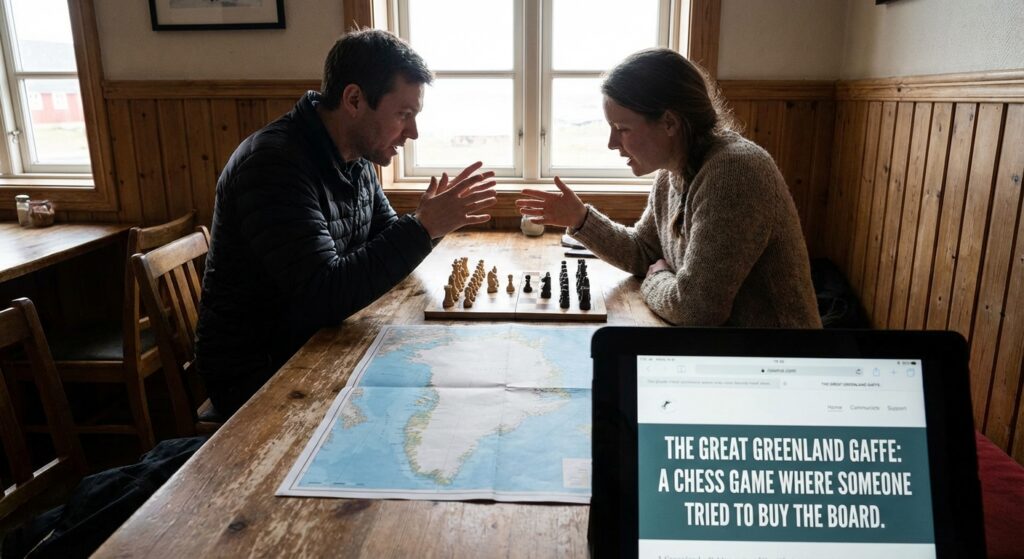
There are moments in geopolitics that feel less like calculated strategy and more like someone unplugged the server mid-update. The 2019 saga of President Trump’s offer to buy Greenland from Denmark was one of those moments. It had the audacious energy of a chess player, instead of moving a pawn, offering to buy their opponent’s queen with cash. It wasn’t just a bold move; it was a move from an entirely different game, possibly Monopoly.
The Board is More Valuable Than You Think
First, let’s get one thing straight: this wasn’t just a whim about acquiring a large, chilly piece of real estate. Greenland is a queen on the geopolitical chessboard, not a pawn. Its strategic value is immense, thanks to:
- Location, Location, Location: It’s the cornerstone of Arctic defense and sits astride potential new shipping lanes as polar ice melts.
- NATO’s Northern Sentry: It hosts Thule Air Base, a critical U.S. military installation that serves as a powerful early-warning radar system. Losing that would be like losing your firewall.
- Untapped Resources: It’s believed to hold vast reserves of rare earth minerals, the secret sauce for all our modern tech.
So, the desire wasn’t illogical. The methodology, however, was like submitting a feature request on a sticky note.
A Diplomatic ‘404 Not Found’
The Danish reaction was a masterclass in polite confusion. Prime Minister Mette Frederiksen called the idea “absurd,” which is the diplomatic equivalent of getting an error message that says, “The function you have requested, ‘SellCountry’, does not exist.” There is no international protocol for this. There’s no form to fill out, no ticket to submit to the global help desk. The US essentially pinged a server that had no port open for that kind of request. The subsequent cancellation of a state visit over the refusal was like a user getting angry at the computer because it couldn’t divide by zero.
The Tariff Subtext
Lurking in the background of this whole affair was the constant, low-humming server noise of trade disputes and tariffs. The move was seen by many as part of a transactional worldview, where alliances and territories are negotiable assets, just like steel imports. It was a chaotic move that ignored the complex, centuries-old firmware of NATO alliances and international diplomacy. It was an attempt to apply a simple commercial logic to a system built on anything but. In the end, the game of chess continued, but everyone was left staring at the Monopoly money someone had thrown on the board, wondering what, exactly, just happened.