
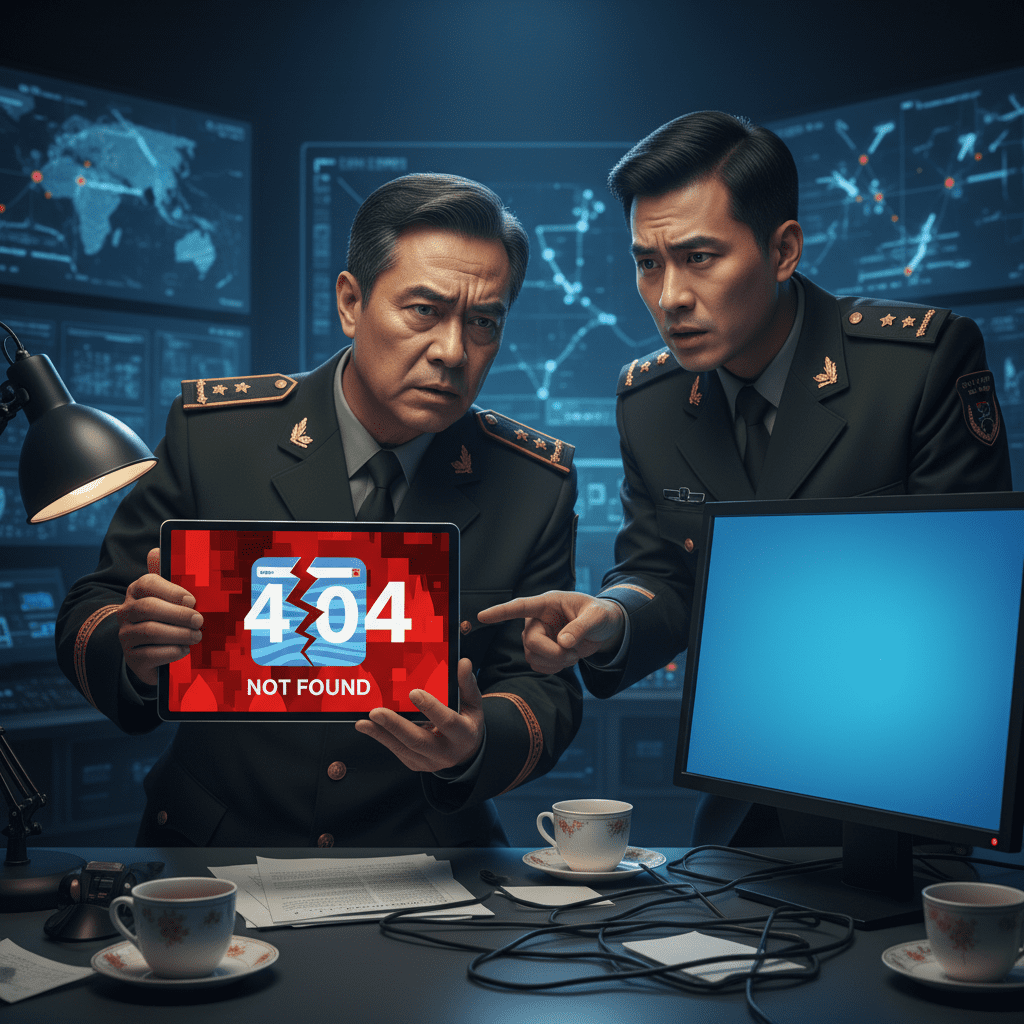
In the corporate world, when a senior executive suddenly leaves, you get a carefully worded email about them “pursuing other opportunities.” In Xi Jinping’s China, when a four-star general vanishes, you get the digital equivalent of a 404 Not Found error. One day they’re inspecting troops, the next their name is scrubbed from official websites, their photos disappear, and everyone pretends their seat at the big table was always just a bit wobbly. It’s not just a military purge; it’s a system-wide administrative cleanup, and the IT department isn’t sending out notifications.
The Official Bug Report: ‘Corruption’
The official reason for these disappearances, when one is given at all, is usually a variation of “severe violations of discipline and law.” This is the geopolitical equivalent of closing a helpdesk ticket with the note “user error.” Corruption is certainly a plausible culprit—it’s the legacy malware that’s been plaguing the system for decades. But treating it as the *only* reason is like blaming a global server outage on a single faulty power strip. It’s a convenient, catch-all explanation that neatly tidies up a much more complex problem.
The Real Patch Notes: A Loyalty Update
What this really looks like is the world’s most intense security audit. Xi Jinping isn’t just running antivirus software; he’s recompiling the entire operating system to ensure absolute loyalty. The goal is to eliminate any potential backdoors, any unauthorized processes, and anyone whose user permissions might exceed their mandate. In this system, loyalty isn’t a feature; it’s the core architecture.
- The Rocket Force Reboot: When the entire leadership of the force managing your nuclear arsenal gets de-provisioned, it’s not about skimming from the catering budget. It suggests a fundamental security concern about who has the admin password to the apocalypse.
- The Defense Minister’s Deletion: When Defense Minister Li Shangfu was ghosted after just a few months, it showed that even the newest user accounts aren’t safe from a permissions review. His crime wasn’t necessarily a bug in his own code, but the fact that he was compiled using a legacy version of the party’s software.
The Global Service Desk Ticket
So why does this bureaucratic black hole matter to the rest of us? Because it makes the system dangerously unpredictable. Imagine trying to set up a critical conference call with a counterpart who might be archived to an offline server farm without warning. The much-discussed military hotline between the U.S. and China is hard to operate when you don’t know if the person on the other end will still have an active account next week. This constant reshuffling creates a command structure where new leaders may be untested, more eager to prove their loyalty, and less familiar with the established protocols. It’s like replacing all your seasoned network engineers with interns during a denial-of-service attack. The potential for a catastrophic system error—one that can’t be fixed by turning it off and on again—grows with every unexplained disappearance.