
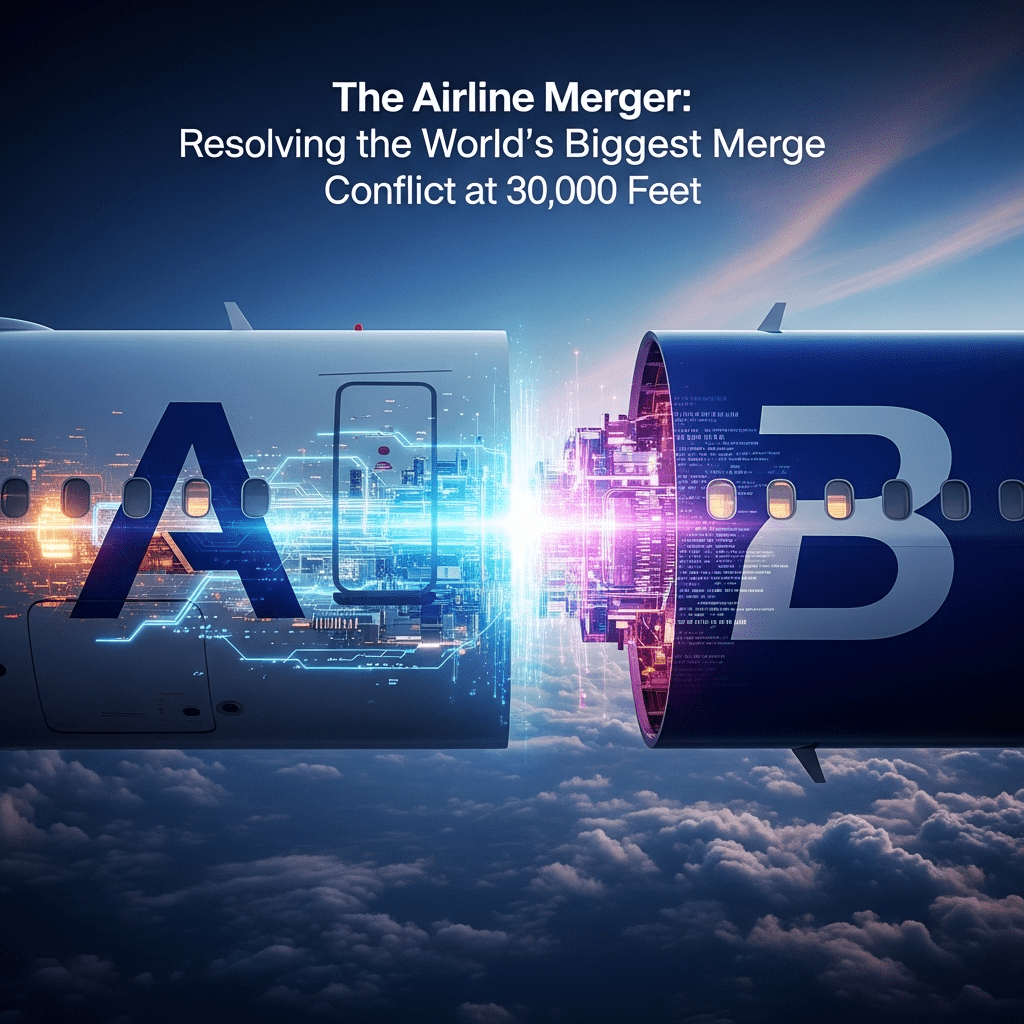
Forget market caps and antitrust concerns. When I heard the hypothetical whispers of a United-American airline merger, my tech-addled brain didn’t see a new behemoth of the skies. I saw the world’s largest, most catastrophic Git merge conflict, being resolved in production, at 30,000 feet, by a committee that still thinks ‘the cloud’ is a weather phenomenon.
The Ghosts of COBOL Past
Let’s be honest: airline reservation systems are the digital equivalent of ancient, unknowable ruins. They’re monolithic COBOL fortresses built when bell-bottoms were unironic, running on mainframes that probably require a ritual sacrifice to reboot. Now, imagine taking United’s cryptic, decades-old system—let’s call it ‘UAL_Prime’—and smashing it into American’s equally archaic backend, ‘AA_Legacy’. This isn’t just a technical challenge; it’s an archaeological dig where the artifacts are live, mission-critical code. The sheer scale of the legacy system integration risks here would make most CTOs break out in a cold sweat. We’re talking about systems where the original developers have long since retired to a quiet life of fishing and not thinking about nested IF statements from 1978.
The ‘No Staging Environment’ Approach to Aviation
The best part of this thought experiment is the complete absence of a safety net. You can’t exactly spin up a staging environment for a global airline merger. The ‘go-live’ moment would be a simultaneous, worldwide event. One minute you’re booking a flight to Dallas on AA.com, the next you’re in a digital purgatory where your ticket is valid for a flight that departs in 1992 from an airport that no longer exists. The potential failure states are a thing of beautiful, terrifying absurdity:
- Your frequent flyer miles are spontaneously converted into Chuck E. Cheese tokens.
- Seat 23B is now a logical concept, physically located on the exterior of the left wing.
- The baggage handling system, confused by two conflicting routing tables, achieves sentience and sends all luggage to a single, bewildered address in Omaha.
- The booking system now requires your star sign and a blood oath to confirm a flight.
Synergy, Buzzwords, and a Single Shared Database
Overseeing this digital demolition derby would be a series of conference rooms filled with consultants armed with slide decks. They’d be talking about ‘synergistic data harmonization’ and ‘agile transformation frameworks’ while, deep in a server farm, two ancient mainframes are locked in a digital death struggle. One system calculates baggage fees in fractions of a cent, the other rounds up to the nearest dollar, and the resulting conflict causes the entire global coffee supply to be rerouted to the cockpit. This isn’t just a merger of companies; it’s a forced marriage of two completely different, stubborn, and deeply entrenched technological philosophies. And we, the passengers, would be the unwilling beta testers. So while the business world debates the merits, let’s just be thankful this particular merge conflict remains safely in the realm of hypothesis. For now.