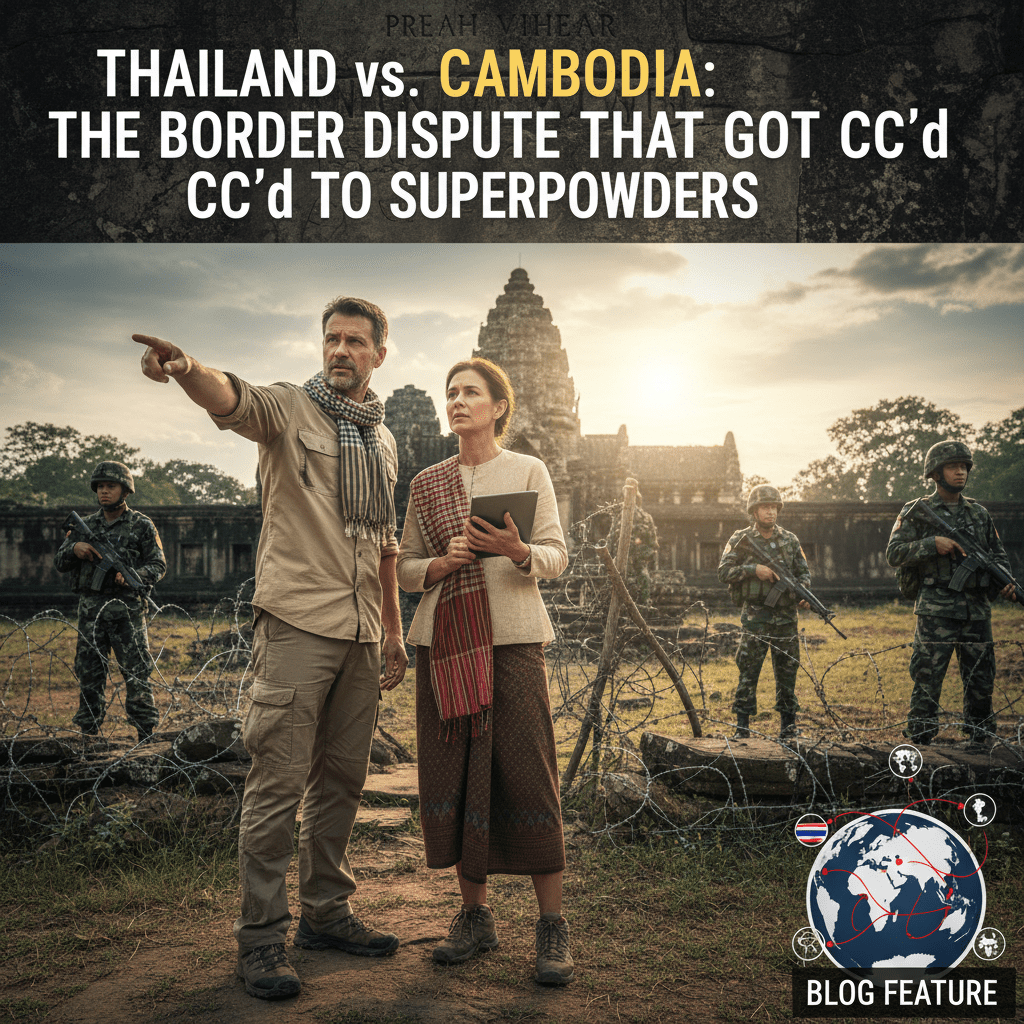
You know that feeling when a simple disagreement with a coworker over who gets to name the shared network folder escalates until VPs from two different continents are CC’d? That’s the Thailand-Cambodia border conflict in a nutshell. It started as a classic “who owns this piece of land” debate and morphed into an international chess game where the original players are almost secondary to the bigwigs who’ve invited themselves to the meeting.
The Original Support Ticket: Preah Vihear
At the heart of this geopolitical saga is the Preah Vihear Temple, a stunning cliffside complex that both nations felt belonged in their “My Documents” folder. After decades of back-and-forth, the International Court of Justice stepped in, acting like the world’s most overqualified IT admin. In 1962, they ruled the temple belonged to Cambodia. Case closed, right? Not quite. The court also decided that the most practical access route was through Thailand, essentially giving one country the file and the other the only desktop shortcut to it. This created a state of perpetual, low-grade bureaucratic friction.
Escalating to Management: Enter the Superpowers
A simple territorial squabble is manageable. But things get interesting when the regional managers—in this case, the United States and China—start weighing in. This isn’t just about a temple anymore; it’s about influence, alliances, and who gets to set the corporate culture for Southeast Asia.
- Team China: Arrives with big investment promises, infrastructure projects, and a “no-strings-attached” management style. They’re the cool new executive who buys everyone lunch but quietly expects you to use their proprietary software for everything.
- Team USA: The legacy partner, offering joint military exercises, long-standing security pacts, and a whole lot of official procedure. They’re the senior manager who insists on following the decades-old company handbook, even when it’s wildly inconvenient.
Suddenly, the border dispute becomes less about historical claims and more about which global operating system the region will run on. The original conflict becomes a background process, a justification for bigger strategic moves. It’s the international equivalent of an argument over the office thermostat being used as a proxy war between the sales and engineering departments.
Can ASEAN Close the Ticket?
And where is the regional mediator in all this? ASEAN, the Association of Southeast Asian Nations, plays the part of the well-meaning but perpetually flustered project manager. They try to get everyone in a room to talk it out, championing dialogue and consensus. But it’s hard to get a resolution when both parties keep forwarding the email chain to their superpower bosses for backup. ASEAN’s pleas for a local solution often get drowned out by the global shouting match, proving that once you escalate an issue to the C-suite, it never really de-escalates. It just gets more complicated.
Leave a Reply