
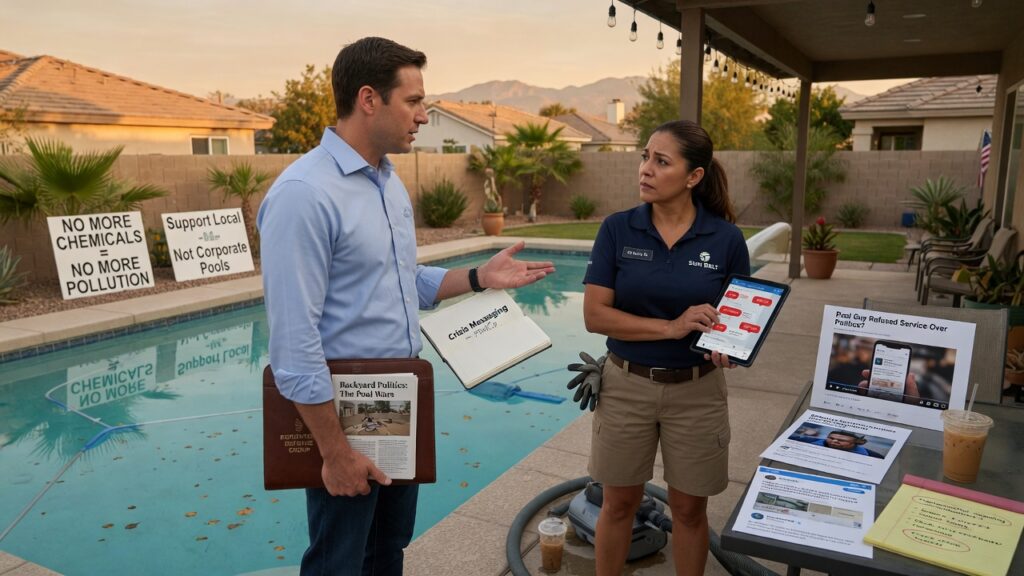
Pool Cleaners Hire Crisis PR as Household Chores Turn Political
In an era where every consumer choice can spark online outrage, even the humble pool cleaner is not immune. Across the Sun Belt, independent pool maintenance companies are quietly retaining crisis public relations firms to navigate a surprising new minefield: politicized backyard chores. What began as routine service calls has escalated into boycotts, viral videos, and accusations of everything from environmental neglect to cultural signaling.
The Unexpected Politicization of Pool Care
Pool cleaning was once a straightforward, apolitical gig. Technicians arrived, balanced chemicals, skimmed debris, and left. Today, social media has transformed the industry. A single TikTok showing a technician using traditional chlorine instead of “natural” alternatives can trigger calls for cancellation. Homeowners now scrutinize service providers for alignment on issues ranging from water conservation to labor practices.
Industry insiders report a sharp uptick in requests for PR support. “We’ve seen a 300% increase in calls from pool service operators in the last 18 months,” says Elena Vargas, founder of SunState Crisis Communications. Her firm, which previously specialized in restaurant and retail clients, now counts six pool companies among its roster. The triggers vary: accusations of overusing chemicals that harm local ecosystems, disputes over immigrant labor, and even debates about whether maintaining a pool signals excess during climate discussions.
Real Cases Fueling the Trend
Consider the case of AquaPro Services in Arizona. Last summer, a customer posted a video claiming the company refused to switch to salt-water systems, labeling the refusal as “climate denial.” The clip amassed 2.4 million views. Within 48 hours, three neighborhood HOAs canceled contracts. AquaPro hired a crisis team that drafted statements emphasizing their use of EPA-compliant products and launched a transparency campaign featuring behind-the-scenes videos of water-testing protocols.
Similar stories have emerged in Florida and California. In one instance, a technician’s offhand remark about “keeping pools great again” was recorded and shared, prompting accusations of partisan signaling. The company responded with a rapid apology tour and diversity training for staff.
These incidents highlight how algorithms reward controversy. A mundane service dispute becomes national news when amplified by partisan accounts. Pool cleaners, often small businesses without dedicated communications staff, find themselves unprepared.
Why Crisis PR Works for Blue-Collar Trades
Crisis PR firms bring playbooks honed in tech and finance to these everyday sectors. Strategies include rapid-response messaging, media monitoring tools, and proactive storytelling. Many pool companies are now adopting tech solutions such as customer apps that log service details, providing receipts that double as proof of responsible practices.
“It’s not just damage control anymore,” explains Vargas. “We’re helping clients build narratives around sustainability and community values before issues arise.” Some firms are integrating IoT sensors that allow homeowners to monitor chemical levels remotely, reducing disputes and creating shareable data points.
The cost is significant for small operators—retainers often start at $8,000 monthly—but the alternative is lost contracts in a competitive market. With labor shortages already pressuring the industry, reputation management has become essential infrastructure.
Broader Implications for Service Industries
The pool cleaning saga reflects a larger shift. From landscapers to HVAC technicians, service providers are discovering that political polarization extends into private homes. Homeowners increasingly view service choices through ideological lenses, whether it’s EV charging compatibility or water usage during droughts.
Tech platforms accelerate the cycle. Review sites and neighborhood apps turn private feedback into public campaigns. Companies without media training risk escalation from one-star reviews to coordinated boycotts.
Experts predict this trend will spread. “Any visible service that touches the home is fair game,” notes sociologist Dr. Marcus Hale. “We’re seeing the weaponization of domestic consumption.”
Looking Ahead: Adaptation or Extinction
Pool cleaners who adapt are investing in training, transparent operations, and sometimes even advocacy. Others are forming industry coalitions to share PR resources. Meanwhile, crisis firms are developing specialized offerings, including AI-powered sentiment analysis tailored to local political climates.
The lesson is clear: in 2024, no chore is too small to become a battleground. Pool cleaners hiring crisis PR represents not absurdity but adaptation to a world where every service interaction carries political weight. As backyard pools continue to symbolize leisure, status, and now ideology, the professionals who maintain them must master the art of narrative alongside chemistry.
For an industry built on clear water, the murkiest challenges now come from the court of public opinion.