
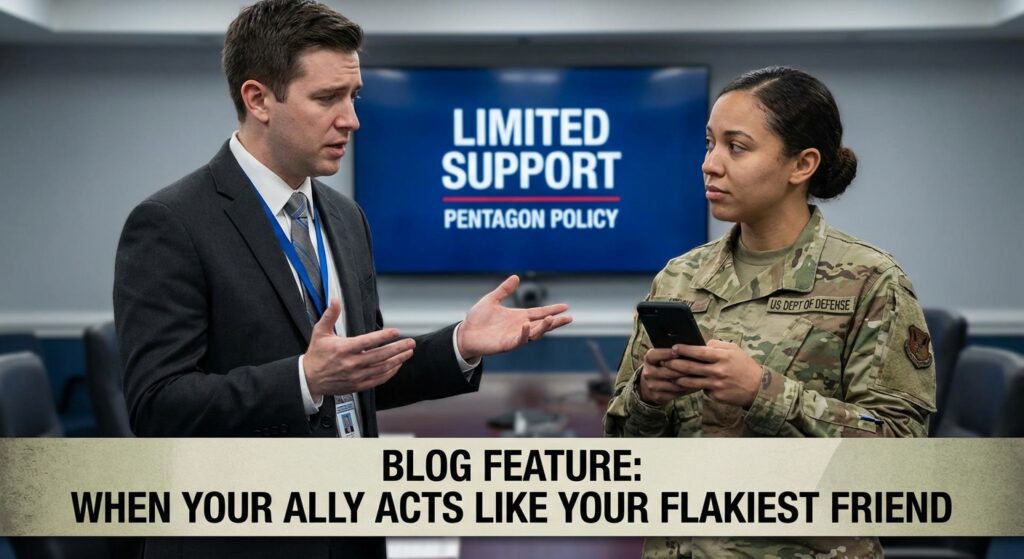
We’ve all got that one friend. The one who replies “I got you!” to your 3 AM “my car broke down” text, then follows up two hours later with “You good now?” This friend is a master of moral support but operates on a dial-up connection when it comes to actual, physical assistance. Well, it seems the Pentagon has adopted this friend’s communication style with its new foreign policy approach of “limited support.” It’s not a breakup, it’s just… a significant downgrade in the service-level agreement.
The Friendship Terms of Service Have Updated
Essentially, “limited support” is the geopolitical equivalent of your friend saying they’ll help you move, but only for the “light stuff” and they “can’t do stairs.” For decades, many allies were on the premium plan: full military support, boots on the ground, the works. Now, it seems many have been moved to a freemium tier. You still get access to the platform, but the best features are behind a “do-it-yourself” wall. It’s less about sending in the cavalry and more about sending a well-produced instructional YouTube video on cavalry maintenance.
What ‘Limited Support’ Looks Like in Practice
To understand this policy shift, let’s compare the old system with the new, friend-based operating system.
- The Old Promise: “We’re in a jam!”
The Old Response: “The 82nd Airborne is on its way with a carrier strike group and three Jamba Juices.” - The New Promise: “We’re in a jam!”
The New Response: “Thoughts and prayers. Have you tried turning your regional conflict off and on again? We’ve shared a helpful whitepaper on de-escalation to your inbox.” - The Old Arms Deal: “We need state-of-the-art fighter jets.”
The Old Response: “Done. They come with free satellite hookups and a complimentary subscription to our defense cloud.” - The New Arms Deal: “We need state-of-the-art fighter jets.”
The New Response: “Excellent choice! We can offer you a discount on last year’s drones and an expired coupon for a tank. Some assembly required.”
Before we panic, this isn’t necessarily a global ghosting. Think of it as the Pentagon trying to manage its own bandwidth. After decades of being everyone’s go-to for every problem, it’s finally setting some boundaries. It’s telling its allies, “I love you, but I can’t be your 24/7 IT help desk, your security guard, and your ride to the airport anymore.” The message is clear: it’s time for allies to build their own IKEA furniture. The Pentagon will still be there to “supervise,” probably from a comfortable chair while sipping a beverage, but you’re going to have to find the Allen key yourself.