
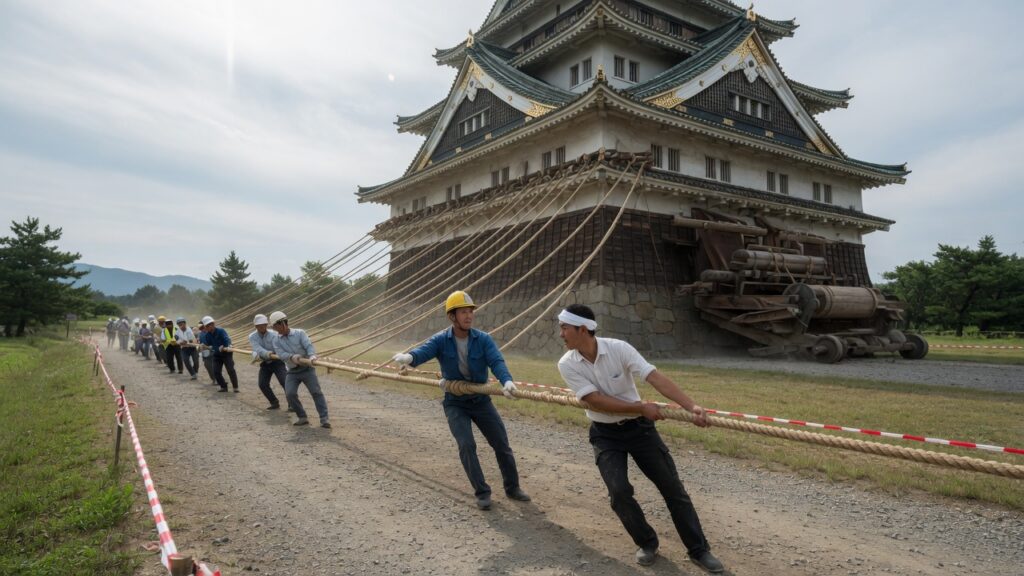
While we complain about moving a couch, an entire town turns heritage relocation into a giant tug-of-war game using ropes and rollers, exposing the hilarious patience of old-school methods in our high-tech world. Japan recently dragged the 400-ton Hirosaki Castle keep across town without a single crane, relying on 1,800 volunteers and pure human grit instead.
Why Manual Muscle Still Beats Modern Cranes
In an age of autonomous drones and AI-optimized logistics, this move highlights when low-tech infrastructure solutions outperform flashy tech. The team used wooden rollers, massive ropes, and coordinated pulling to shift the structure safely, avoiding vibrations that could damage centuries-old timber. It is a reminder that some heritage or legacy assets simply cannot tolerate high-speed automation.
Tech Parallels In Data Center Relocations
Think of it as migrating a massive on-prem server rack without cloud tools: you plan every millimeter, test the path repeatedly, and accept slower timelines to prevent data loss. Hirosaki’s approach mirrors careful hardware moves where one wrong jolt corrupts everything, proving that patience scales better than horsepower in fragile environments.
Volunteer Coordination As Distributed Computing
Coordinating 1,800 people required real-time human networking that would make any DevOps team jealous. Hand signals, synchronized chants, and precise positioning replaced apps and sensors, delivering zero-downtime relocation. The result exposes a surprising infrastructure truth: sometimes the most reliable system is still the one with people at its core.
Policy Lessons For Sustainable Moves
Modern projects chasing net-zero goals could learn from this zero-emission strategy. No diesel cranes meant lower carbon output and preserved cultural integrity, showing that heritage policy and green infrastructure can align without expensive tech upgrades.