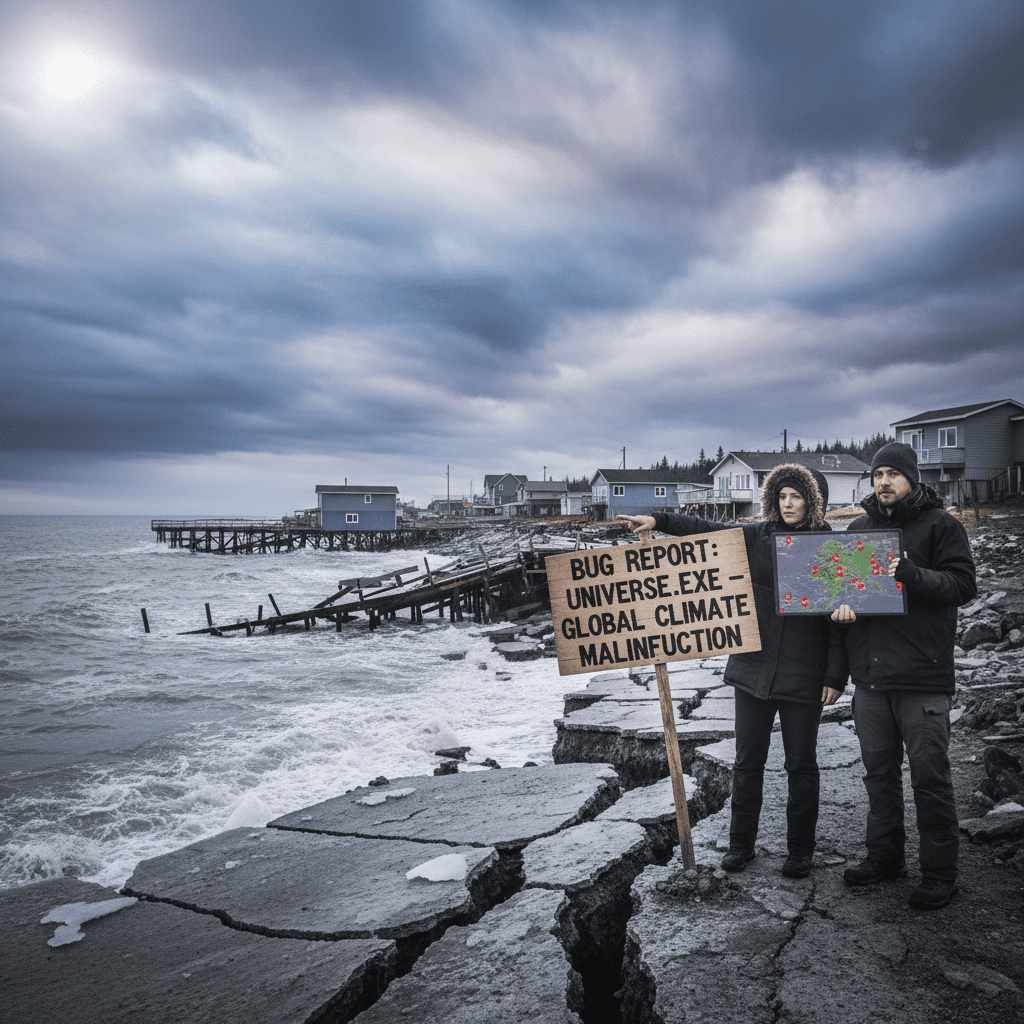
You know that special kind of existential dread that sets in when you have to call customer service? You’ve got your account number, you’ve rehearsed your issue, and you’re prepared to navigate a phone tree designed by a mischievous labyrinth-maker. Now, imagine that, but instead of a faulty router, your problem is that your entire town is gently sliding into the ocean. Welcome to the bureaucratic wonderland facing Alaska Native villages, the front line of climate displacement in the U.S.
The Ultimate 404 Error: Land Not Found
For centuries, villages like Newtok and Kivalina have thrived in coastal Alaska. Their foundations were built on something called permafrost—basically, nature’s concrete. But as the climate warms, that permafrost is thawing into a slushy, soupy mess. Combine that with the disappearance of coastal sea ice that once acted as a storm buffer, and you get erosion on an epic scale. It’s less of a slow-moving disaster and more of a geological “un-delivery” notification. The land you ordered has been returned to sender, the sender being the Bering Sea.
So, what do you do when your home is succumbing to the world’s slowest-moving natural disaster? You fill out paperwork, of course. Lots of it. The challenge of alaska native village climate displacement isn’t just a physical one; it’s an administrative odyssey. Here’s a peek at the user journey:
- The Catch-22 of Disaster Declarations: To get major federal disaster relief from an agency like FEMA, you typically need a sudden, catastrophic event—a hurricane, a flood, an earthquake. A town losing 50 feet of land per year is apparently considered a “long-term character-building exercise.” It’s not a single disaster; it’s a subscription service to catastrophe.
- The Alphabet Soup of Agencies: A whole conga line of federal and state agencies wants to “help.” The Army Corps of Engineers, the Bureau of Indian Affairs (BIA), Housing and Urban Development (HUD), and a dozen others all have their own grants, their own rules, and their own 100-page application forms that probably require a notary who can travel by snow machine.
- The Wrong Tools for the Job: Many government programs are designed for urban infrastructure or post-tornado rebuilding. They aren’t equipped to handle the concept of moving an entire community, its cultural sites, and its subsistence lifestyle from Point A to a yet-to-be-built Point B. It’s like trying to fix a software bug by hitting the computer with a hammer. You might change something, but it’s probably not for the better.
The result is a maddening loop where communities are deemed “at risk” but not “in imminent danger” enough to qualify for the big funds. They’re stuck in a bureaucratic holding pattern, watching their ancestral lands wash away while waiting for a committee in a faraway office to approve form 37-B, subsection C, for a preliminary feasibility study.
CTRL+ALT+DEL on an Entire Village
So, the next time you’re frustrated because a web form won’t accept your password, spare a thought for the folks in Alaska. They’re dealing with the same maddening logic, but the error message is their home disappearing into the waves. It’s the ultimate test of resilience, not just against a changing planet, but against the absurdity of the systems we’ve built to deal with it.
Leave a Reply