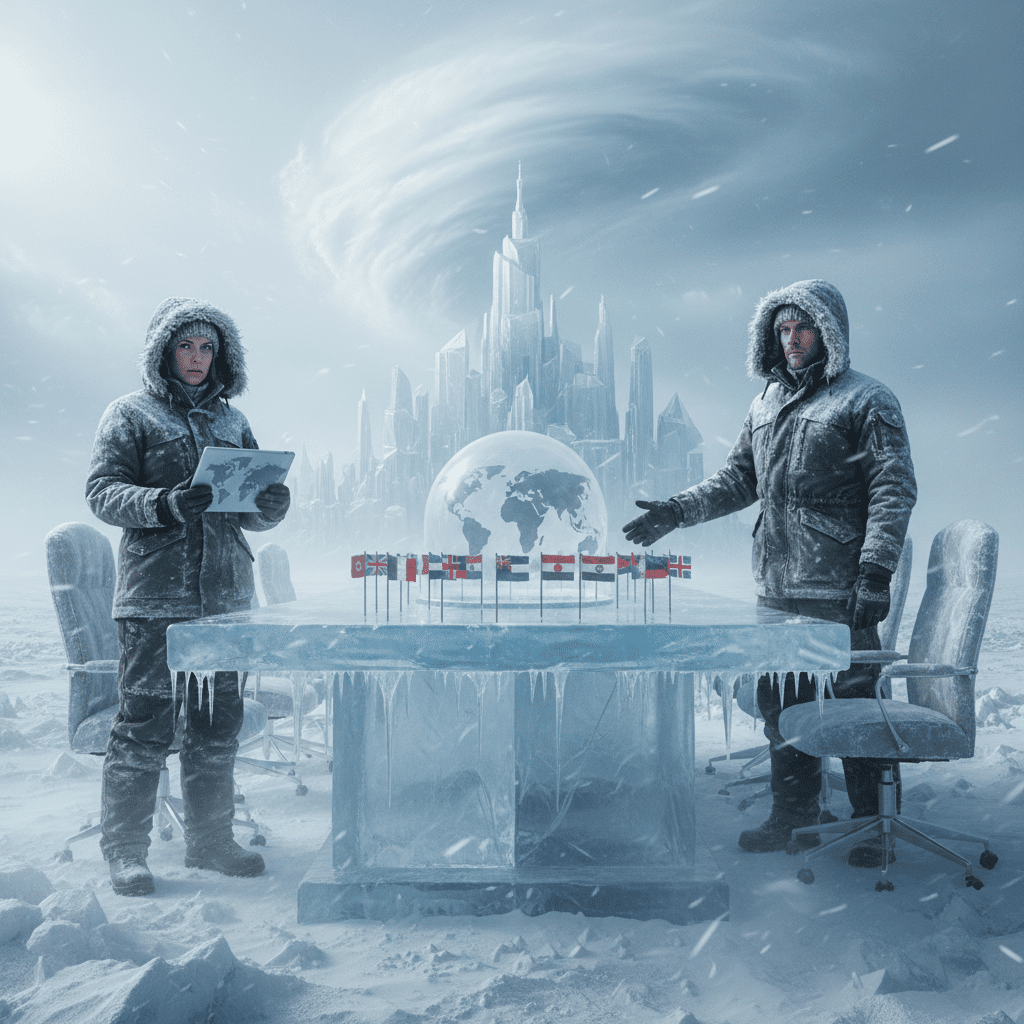
It’s official: the world has put on its emergency thermal underwear. As a polar vortex turns doorknobs into instruments of icy torment, we’re all huddled inside, staring at our routers and wondering if the blinking lights are generating enough heat to matter. But there’s another, less literal chill in the air. I’m talking about the great global diplomatic freeze, a phenomenon that makes this weekend’s weather look like a balmy afternoon in July.
The Handshake Protocol Timed Out
In the world of networking, a simple three-way handshake establishes a connection. It’s a polite, digital ‘how-do-you-do.’ Lately, international relations feel like a series of SYN packets being sent into the void, with no ACK in return. The connection just… times out. It’s as if the entire diplomatic corps is operating on legacy hardware, running an OS so old it considers a strongly worded letter to be a ‘denial-of-service’ attack. Every negotiation feels like trying to load a high-res video on a dial-up modem; you get a lot of screeching, a frozen screen, and eventually, you just give up and go make a sandwich.
Symptoms of System-Wide Lag
- Frozen Summits: Leaders gather for what looks like the world’s most expensive video call where everyone’s connection is lagging. You see mouths moving, but the audio doesn’t sync up for six to eight months.
- Dropped Packets of Goodwill: Attempts at cooperation are like data packets sent over a faulty network. They’re dispatched with the best intentions but get lost somewhere over the mid-Atlantic, never to be seen again.
- Firewall of National Interest: Every nation’s firewall seems to be configured to ‘Deny All.’ Trying to pass a simple trade agreement through is like trying to convince your corporate IT department to let you install a video game.
Searching for the Global Ctrl+Alt+Del
So what’s the fix? There’s no global help desk to call, no ticket to submit to the universe’s IT department. The user manual is ten thousand pages long and half the chapters contradict the other half. Someone, somewhere, insists the solution is to ‘turn it off and on again,’ but nobody can agree on where the power button is. As we wait for this geopolitical system to thaw, maybe the best we can do is what we’re already doing for the polar vortex: put on another sweater, make some hot chocolate, and hope someone remembers the administrator password soon.
Leave a Reply